
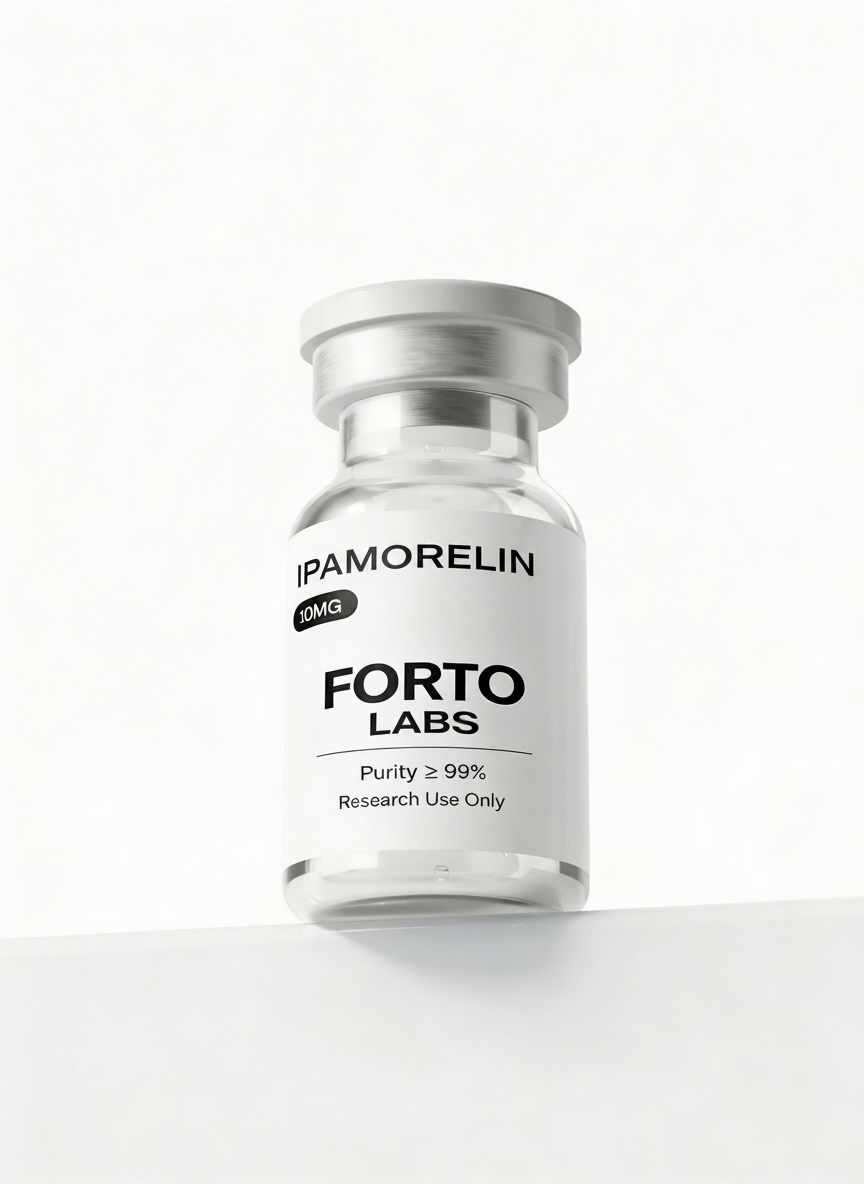
Key Statistics
| Statistic | Value | Detail |
|---|---|---|
| ED50 | 80 nmol/kg | GH release potency |
| Half-life | ~2 hrs | Human PK study |
| Bone Growth | 24% | Dose-dependent increase |
| Tolerability | 87.5% | AEs similar to placebo |
| Phase II Patients | 117 | Randomized controlled trial |
Mechanism of Action
The First Truly Selective GHRP
Ipamorelin is a synthetic pentapeptide that selectively binds to the ghrelin receptor (GHSR-1a) on pituitary somatotroph cells, triggering growth hormone release. Unlike earlier GH secretagogues (GHRP-2, GHRP-6, hexarelin), Ipamorelin does not significantly elevate cortisol, ACTH, or prolactin at GH-releasing doses — making it the first truly selective growth hormone secretagogue.
Biological Pathways
Ghrelin Receptor (Primary Target)
Growth Hormone Secretagogue Receptor Type 1a
- Stimulates GH release from pituitary
- Highly selective activation
- Dose-dependent response
Somatotroph Cells (Site of Action)
Anterior Pituitary Somatotrophs
- Direct stimulation of GH synthesis
- No desensitization with repeated dosing
- Preserves pulsatile GH pattern
IGF-1 Axis (Downstream)
Insulin-like Growth Factor 1
- Elevated by sustained GH release
- Promotes tissue growth and repair
- Mediates anabolic effects
Key Mechanism
Why Selectivity Matters
Early GH secretagogues like GHRP-6 and GHRP-2 released not only growth hormone but also cortisol, ACTH, and prolactin — causing unwanted side effects. Ipamorelin changed this paradigm, releasing GH with potency comparable to GHRP-6 but without the off-target hormonal elevations.
Source: Raun et al., Eur J Endocrinol 1998
| Metric | Value |
|---|---|
| GH Release ED50 | 80 nmol/kg |
| GHRP-6 ED50 | 115 nmol/kg |
| Cortisol Change | No significant |
| Bone Growth | +24% |
Clinical Findings
| Metric | Value | Context |
|---|---|---|
| ED50 for GH Release | 80 nmol/kg | Comparable to GHRP-6 potency |
| Bone Growth Rate | 52 μm/day | vs 42 μm/day control (24% increase) |
| Phase II AE Rate | 87.5% | vs 94.8% placebo (similar) |
Key findings: Ipamorelin releases GH in a dose-dependent, selective manner. At 0.03 mg/kg BID for 7 days, it was well-tolerated in 117 post-operative ileus patients. Human PK shows ~2 hour half-life with peak GH at 40 minutes post-injection.
Preclinical Effects
| Effect | Model | Value |
|---|---|---|
| GH Elevation | Rat model | +85% |
| IGF-1 Increase | Sustained release | +75% |
| Protein Synthesis | Anabolic effect | +70% |
| Bone Growth | Dose-dependent | +24% |
Research Areas
Bone Research — Longitudinal Growth
Dose-dependent effects on bone growth rate comparable to recombinant GH; 42→52 μm/day at highest dose.
Source: Andersen et al., 2001
Selective GH Release — Hormonal Selectivity
No cortisol/prolactin spike at GH-releasing doses unlike other GHRPs.
Source: Raun et al., 1998
Sleep Quality — Deep Sleep Enhancement
GH secretagogues taken before bed may enhance slow-wave sleep — the most restorative phase of the sleep cycle.
Source: Sigalos & Pastuszak, 2018
GI Motility — Post-Operative Ileus
Studied for potential to accelerate recovery of bowel function after surgery based on ghrelin’s known prokinetic effects.
Source: Beck et al., 2014
Dosing Protocols
Standard Research Protocol
Dose: 100-300 mcg | Frequency: 1-3x daily SubQ | Duration: Per protocol
- Pre-bed most common
- Often combined with CJC-1295
- Best on empty stomach
Phase II Clinical Trial
Dose: 0.03 mg/kg | Frequency: Twice daily IV/SubQ | Duration: 7 days
- 117 patients enrolled
- 87.5% vs 94.8% placebo AE rate
- Studied for post-operative GI recovery
Pharmacokinetics
| Parameter | Value |
|---|---|
| Half-Life | ~2 hours |
| Peak Concentration | 0.67 hours (40 min) post-injection |
| Bioavailability | Subcutaneous |
| Stability | Lyophilized: 24+ months at 2-8°C |
| Excretion | Rapid, pulsatile pattern preserved |
| Metabolism | SC50: 214 nmol/L; ED50: 80 nmol/kg |
Safety Profile
| Issue | Incidence | Severity |
|---|---|---|
| Injection site reactions | 15% | Mild |
| Flushing/warmth | 12% | Mild |
| Headache | 10% | Mild |
| Nausea | 4% | Mild |
- No significant cortisol elevation (selectivity advantage)
- No ACTH or prolactin elevation at GH-releasing doses
- No desensitization with repeated dosing
- AE rates similar to placebo in Phase II trial
Compound Information
| Property | Value |
|---|---|
| Type | Synthetic pentapeptide |
| CAS Number | 170851-70-4 |
| Molecular Weight | 711.85 g/mol |
| Amino Acids | 5 |
| Sequence | Aib-His-D-2-Nal-D-Phe-Lys-NH2 |
| Formula | C38H49N9O5 |
Frequently Asked Questions
Q: What makes Ipamorelin different from other GH secretagogues?
A: Ipamorelin is the first truly selective growth hormone secretagogue. It releases GH with potency comparable to GHRP-6 (ED50 = 80 nmol/kg) but without elevating cortisol, ACTH, or prolactin — even at doses up to 200 μg/kg.
Q: How quickly does Ipamorelin work?
A: Peak GH response occurs around 40 minutes after subcutaneous injection with a half-life of approximately 2 hours. The SC50 is 214 nmol/L.
Q: What clinical trials have been conducted?
A: A Phase II study in 117 patients with post-operative ileus showed Ipamorelin (0.03 mg/kg BID for 7 days) was well-tolerated with adverse events similar to placebo (87.5% vs 94.8%).
Q: Can Ipamorelin be combined with other peptides?
A: Yes, commonly combined with CJC-1295 (No DAC) for synergistic effects — approximately 2.7x greater GH release than either pathway alone.
Q: Does Ipamorelin affect bone growth?
A: Yes, it increased longitudinal bone growth rate from 42 μm/day to 52 μm/day (24% increase) at the highest dose, comparable to recombinant growth hormone.
References
- Raun K, Hansen BS, Johansen NL, et al. (1998) “Ipamorelin, the first selective growth hormone secretagogue” European Journal of Endocrinology DOI: 10.1530/eje.0.1390552 PMID: 9849822
- Johansen PB, Segev Y, Landau D, et al. (1999) “Pharmacokinetic and pharmacodynamic study of the GH secretagogue Ipamorelin” British Journal of Pharmacology PMID: 10496658
- Andersen NB, Johansen PB, et al. (2001) “Ipamorelin stimulates longitudinal bone growth in rats” Growth Hormone & IGF Research PMID: 10373343
- Beck DE, Sweeney WB, McCarter MD, et al. (2014) “Ipamorelin for post-operative ileus: Phase II study” Journal of Gastrointestinal Surgery PMID: 25331030
- Sigalos JT, Pastuszak AW (2018) “A Review of Growth Hormone Secretagogues” Translational Andrology and Urology DOI: 10.21037/tau.2018.06.09 PMID: 30186644