
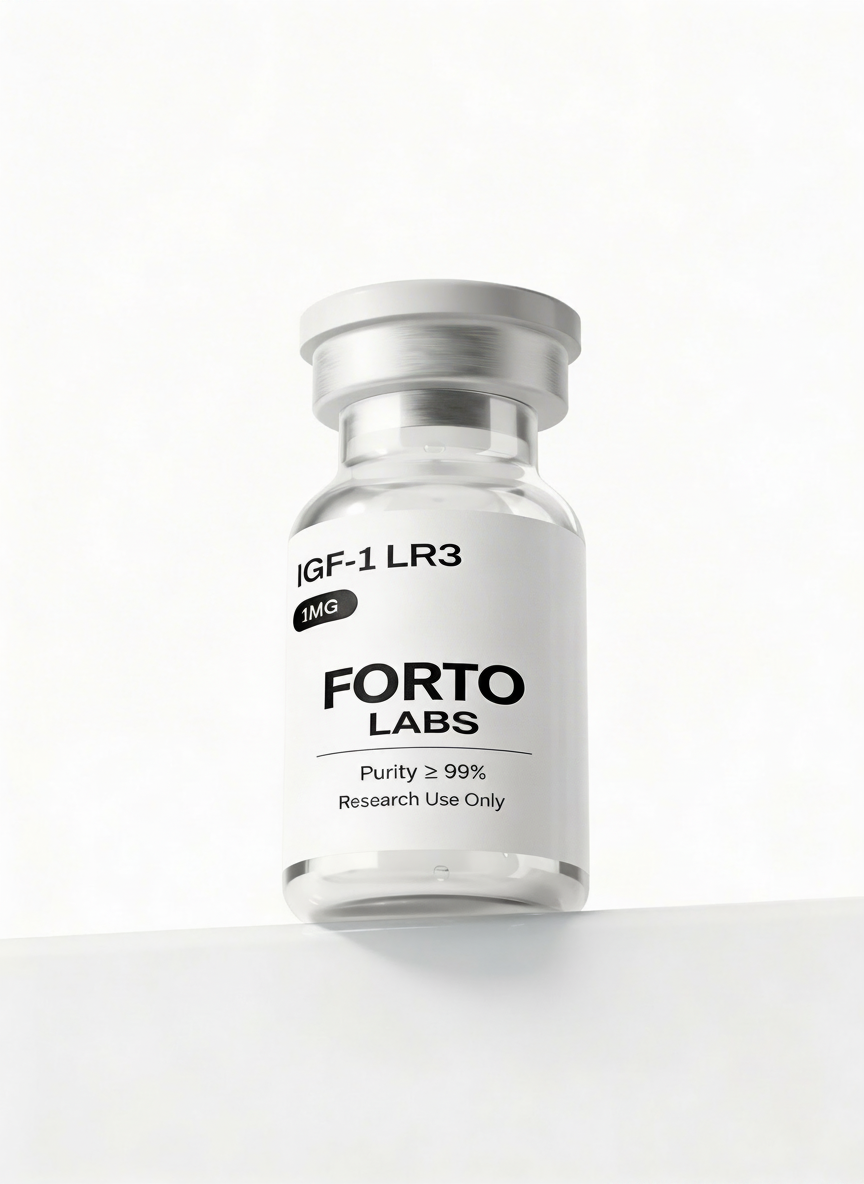
Key Statistics
| Statistic | Value | Detail |
|---|---|---|
| More Potent | 2.5× | vs native IGF-1 |
| Half-life | 20-30 hrs | vs 12-15 hrs native |
| Amino Acids | 83 | vs 70 for native IGF-1 |
| IGFBP Affinity | Low | Bypasses binding proteins |
| Status | Preclinical | No human trials |
Mechanism of Action
Enhanced IGF-1 Analog
IGF-1 LR3 is a synthetic analog of human insulin-like growth factor 1 with two key modifications: an arginine substitution at position 3 and an additional 13 amino acids at the N-terminus. These changes reduce binding to IGF-binding proteins (IGFBPs) while maintaining full agonist activity at the IGF-1 receptor, resulting in enhanced potency and prolonged half-life.
Biological Pathways
IGF-1 Receptor (Full Agonist)
Insulin-like Growth Factor 1 Receptor
- Activates PI3K/Akt signaling
- Stimulates mTOR pathway
- Promotes protein synthesis
Reduced IGFBP Binding (Very Low Affinity)
IGF Binding Proteins
- Bypasses sequestration
- Increased free/bioactive fraction
- Extended duration of action
PI3K/Akt/mTOR (Downstream)
Protein Kinase B / mTOR
- Protein synthesis activation
- Cell proliferation and growth
- Anti-apoptotic signaling
Key Mechanism
Why the N-Terminal Extension Matters
Native IGF-1 is rapidly sequestered by six different IGF-binding proteins (IGFBP-1 through 6), which regulate its bioavailability. The 13-amino acid N-terminal extension in IGF-1 LR3 dramatically reduces this binding, allowing more free peptide to reach target tissues with approximately 3-fold greater potency.
Source: Tomas et al., J Endocrinol 1996
| Metric | Value |
|---|---|
| Anabolic Potency | 250% of IGF-1 |
| Half-life | 20-30 hours |
| IGFBP Binding | ~10% of native |
| Gut Weight Increase | +45% |
Clinical Findings
| Metric | Value | Context |
|---|---|---|
| Anti-catabolic Potency | 2.5× | More potent than native IGF-1 |
| Gut Weight Increase | +45% | At highest dose tested |
| Protein Breakdown Reduction | 3× | 3-methylhistidine excretion |
All studies to date have been preclinical (animal models). No human clinical trials have been conducted with IGF-1 LR3. Results in humans may differ significantly.
Preclinical Effects
| Effect | Model | Value |
|---|---|---|
| Anabolic Effect | Dex-treated rats | 2.5× |
| Gut Weight | Highest dose | +45% |
| Spleen Weight | Organ growth | +35% |
| Kidney Weight | Organ growth | +30% |
Research Areas
Muscle Research — Protein Synthesis & Anti-Catabolism
Coordinate effects on both protein synthesis (increased) and protein breakdown (decreased) with enhanced nitrogen retention.
Source: Tomas et al., 1992
Tissue Growth — Organ & Visceral Effects
Pronounced effects on visceral organ growth, particularly the gastrointestinal tract (+45% gut weight at highest dose).
Source: Conlon et al., 1995
Neuroprotection — Cognitive Research
Intranasal IGF-1 LR3 studied for potential to delay cognitive decline in animal models, leveraging enhanced bioavailability.
Source: PMC 2025 Study
Recovery Research — Catabolic State Reversal
Particular promise in reversing glucocorticoid-induced catabolism: +6g weight recovery vs -19g control over 7 days.
Source: Tomas et al., 1992
Dosing Protocols
Continuous Infusion (Animal)
Dose: 120-695 mcg/day | Frequency: Osmotic pump | Duration: 7 days
- Greater efficacy than injection
- Doses for ~150g rats — not directly translatable
Subcutaneous (Animal)
Dose: 320-400 mcg/day | Frequency: 1-2x daily | Duration: 7 days
- Higher doses showed dose-dependent effects
- No human dosing established
Pharmacokinetics
| Parameter | Value |
|---|---|
| Half-Life | 20-30 hours |
| Peak Concentration | Extended (reduced IGFBP sequestration) |
| Bioavailability | Enhanced (free fraction increased) |
| Stability | Lyophilized: 2-8°C or -20°C long-term |
| Excretion | Rapid when unbound |
| Metabolism | IGF-1R retained affinity; very low IGFBP binding |
Safety Profile
| Issue | Incidence | Severity |
|---|---|---|
| Hypoglycemia risk | Moderate | Moderate |
| Organ hypertrophy | Dose-dependent | Moderate |
| Fluid retention | Possible | Mild |
- Animal studies generally well-tolerated at tested doses
- No human clinical safety data exists
- Greater hypoglycemia risk at equivalent doses vs native IGF-1
- Extended duration of action (20-30 hr half-life) amplifies effects
Compound Information
| Property | Value |
|---|---|
| Type | Synthetic IGF-1 analog |
| CAS Number | 143045-27-6 |
| Molecular Weight | 9,117.60 g/mol |
| Amino Acids | 83 |
| Sequence | N-terminal extended, Arg³ substitution |
| Formula | C400H625N111O115S9 |
Frequently Asked Questions
Q: What is the difference between IGF-1 LR3 and native IGF-1?
A: IGF-1 LR3 has an arginine substitution at position 3 and 13 additional N-terminal amino acids (83 total vs 70). This dramatically reduces IGFBP binding while maintaining full IGF-1R activity, resulting in ~3-fold greater potency and 20-30 hour half-life (vs 12-15 hours native).
Q: Why does reduced IGFBP binding make it more potent?
A: IGFBPs bind and sequester native IGF-1, limiting bioactive peptide. By reducing IGFBP binding, IGF-1 LR3 remains bioactive longer with a greater proportion reaching target tissues — 1.5-2x more potent for body weight, organ weights, and feed efficiency in animal models.
Q: Has IGF-1 LR3 been tested in humans?
A: No. All available research comes from preclinical animal studies, primarily in rats. No human clinical trials have been conducted to establish safety, efficacy, or appropriate dosing.
Q: What were the main animal study findings?
A: In dexamethasone-induced catabolic rats, IGF-1 LR3 was ~2.5x more potent than native IGF-1 in reversing weight loss. The highest dose produced +6g body weight over 7 days (vs -19g control), increased gut weight by 45%, and reduced protein breakdown by 3x.
Q: Is IGF-1 LR3 banned in sports?
A: Yes. IGF-1 LR3 is listed on the WADA Prohibited List under S2 category, banned both in-competition and out-of-competition in all sports.
References
- Tomas FM, et al. (1992) “IGF-I and especially IGF-I variants are anabolic in dexamethasone-treated rats” Biochemical Journal DOI: 10.1042/bj2820091 PMID: 1371669
- Tomas FM, Lemmey AB, Read LC, Ballard FJ (1996) “Superior potency of infused IGF-I analogues which bind poorly to IGF-binding proteins” Journal of Endocrinology DOI: 10.1677/joe.0.1500077 PMID: 8708565
- Mohan S, Baylink DJ (2002) “IGF-binding proteins are multifunctional” Journal of Endocrinology DOI: 10.1677/joe.0.1750019 PMID: 12379487
- von der Thüsen JH, et al. (2011) “IGF-1 has plaque-stabilizing effects in atherosclerosis” American Journal of Pathology DOI: 10.1016/j.ajpath.2010.10.007 PMID: 21281823
- Conlon MA, Tomas FM, et al. (1995) “Long R3 IGF-I infusion stimulates organ growth” Journal of Endocrinology DOI: 10.1677/joe.0.1460247 PMID: 7561636