
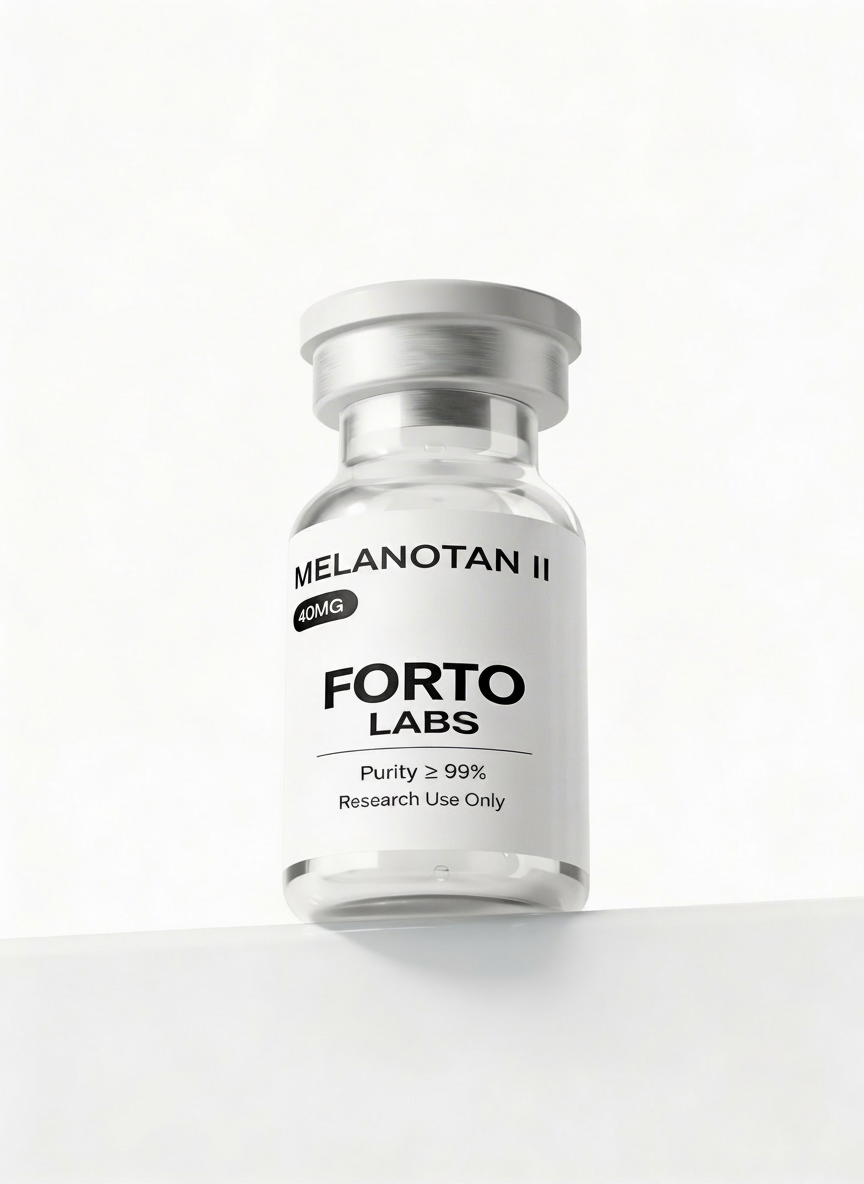
Key Statistics
| Statistic | Value | Detail |
|---|---|---|
| Erectile Response | 85% | 17/20 vs 3/20 placebo |
| Rigidity Duration | 40min | Mean tip rigidity >80% |
| Tanning Effect | No UV | UV-independent pigmentation |
| Non-Tanner Friendly | MC1R | Works despite genetic variants |
| Appetite Suppression | ↓ appetite | MC4R-mediated effect |
Mechanism of Action
Multi-Receptor Melanocortin Activation
Melanotan II activates multiple melanocortin receptors, producing pigmentation (MC1R), pro-erectile effects (MC4R), and appetite modulation (MC3R/MC4R) through distinct but overlapping signaling pathways.
Biological Pathways
MC1R Activation (Pigmentation) (Primary)
Melanocortin-1 Receptor
- Stimulates eumelanin synthesis
- cAMP-PKA signaling pathway
- Works despite MC1R variant alleles
MC4R Activation (Sexual Function) (Primary)
Melanocortin-4 Receptor
- Pro-erectile signaling pathways
- Independent of NO/cGMP mechanisms
- CNS-mediated effects
MC3R/MC4R (Appetite & Metabolism) (Modulatory)
Energy Homeostasis Modulation
- Modulates energy homeostasis
- Appetite suppression
- Increased metabolic rate
Key Mechanism
Dual Peripheral & Central Effects
Melanotan II produces both peripheral pigmentation through MC1R on melanocytes and central nervous system effects through MC4R in the hypothalamus. The 2006 RCT showed tanning even in subjects with MC1R variants who typically cannot tan.
Source: Barnetson (2006)
| Metric | Value |
|---|---|
| Melanin Increase (active group) | 100% |
| Erectile Response Rate | 85% |
| Subjects Enrolled (RCT) | 77 |
| MC1R Variants Effective | Yes |
Clinical Findings
| Metric | Value | Context |
|---|---|---|
| Erectile Response Rate | 85% | vs 15% placebo (Wessells 1998) |
| All Showed Melanin Increase | 100% | Active treatment group |
| Pro-Erectile Duration | 40 min | Mean tip rigidity >80% |
Results from randomized controlled clinical trials. Melanotan II is not FDA approved and remains a research compound.
Preclinical Effects
| Effect | Model | Value |
|---|---|---|
| Erectile Response | Double-blind crossover | +85% |
| Melanin Synthesis | UV-independent | 100% participants |
| Appetite Suppression | MC4R-mediated | Commonly reported |
| Photoprotection | Increased eumelanin | Enhanced UV defense |
Research Areas
Pigmentation — Melanin synthesis activation
Stimulates eumelanin production through MC1R, producing UV-independent tanning even in non-tanners
Source: Barnetson (2006)
Sexual Function — Pro-erectile effects
85% erectile response rate vs 15% placebo via MC4R activation
Source: Wessells (1998)
Appetite & Metabolism — MC4R-mediated effects
Central melanocortin receptor activation modulates energy homeostasis and appetite suppression
Source: Clinical observations
Photoprotection — Enhanced UV defense
Increased eumelanin provides greater UV protection to skin
Source: Hadley & Dorr (2006)
Dosing Protocols
Pigmentation Protocol (Barnetson 2006)
Dose: 0.010-0.025 mg/kg | Frequency: Once daily SubQ | Duration: 10+ days
- Effects accumulate over days
- Pigmentation persists weeks after cessation
- Subcutaneous injection preferred
Erectile Function Protocol (Wessells 1998)
Dose: 0.025 mg/kg SubQ | Frequency: As needed | Duration: Single dose
- Onset: 30-60 minutes
- Duration: 4-6 hours pro-erectile window
- Peak effects at 2-4 hours
Pharmacokinetics
| Parameter | Value |
|---|---|
| Half-Life | 1.5-2 hours |
| Peak Concentration | 2-4 hours (peak effect) |
| Bioavailability | Subcutaneous administration |
| Stability | Cyclic structure provides stability vs linear α-MSH |
| Excretion | Standard peptide metabolism |
| Metabolism | 30-60 minute onset |
Safety Profile
| Issue | Incidence | Severity |
|---|---|---|
| Nausea | 40% | mild |
| Facial flushing | 35% | mild |
| Fatigue/Yawning | 20% | mild |
- Side effects are dose-dependent and typically diminish with continued use
- Nausea most common initial side effect
- Monitor skin for concerning mole changes
Compound Information
| Property | Value |
|---|---|
| Type | Synthetic cyclic heptapeptide |
| CAS Number | 121062-08-6 |
| Molecular Weight | 1,024.18 g/mol |
| Amino Acids | 7 (cyclic) |
| Sequence | Ac-Nle-c[Asp-His-D-Phe-Arg-Trp-Lys]-NH2 |
| Formula | C50H69N15O9 |
Frequently Asked Questions
Q: How does Melanotan II cause tanning without UV?
A: It activates MC1R receptors on melanocytes, triggering the same cAMP-PKA pathway that UV light activates. This stimulates eumelanin synthesis directly, even in individuals with MC1R genetic variants who typically cannot tan.
Q: What is the difference between Melanotan I and Melanotan II?
A: Melanotan I is a linear 13-amino acid peptide primarily targeting MC1R. Melanotan II is a cyclic 7-amino acid peptide with high affinity for both MC1R (tanning) and MC4R (sexual function). Melanotan I has been developed as a prescription drug (Scenesse).
Q: Is Melanotan II the same as PT-141?
A: PT-141 (bremelanotide) was developed from Melanotan II by modifying the structure to reduce pigmentation while preserving sexual function. PT-141 received FDA approval in 2019 for HSDD in women.
Q: Why does Melanotan II cause nausea?
A: Nausea is caused by central MC4R activation in brain areas that regulate appetite and nausea. The effect is dose-dependent and typically diminishes with continued use.
References
- Barnetson RS, et al. (2006) “A randomized controlled trial of melanotan II in the induction of eumelanin synthesis” British Journal of Dermatology PMID: 16293341
- Wessells H, et al. (1998) “Synthetic melanotropic peptide initiates erections in men with psychogenic erectile dysfunction” Urology PMID: 9679884
- Dorr RT, et al. (1996) “Evaluation of melanotan-II in a pilot phase-I clinical study” Life Sciences PMID: 8831529
- Hadley ME, Dorr RT (2006) “Discovery and development of novel melanogenic drugs: Melanotan-I and -II” Peptides PMID: 16289566
- Diamond LE, et al. (2004) “Effect of sexual response in premenopausal women by bremelanotide (PT-141)” Int J Impotence Research PMID: 15073503