
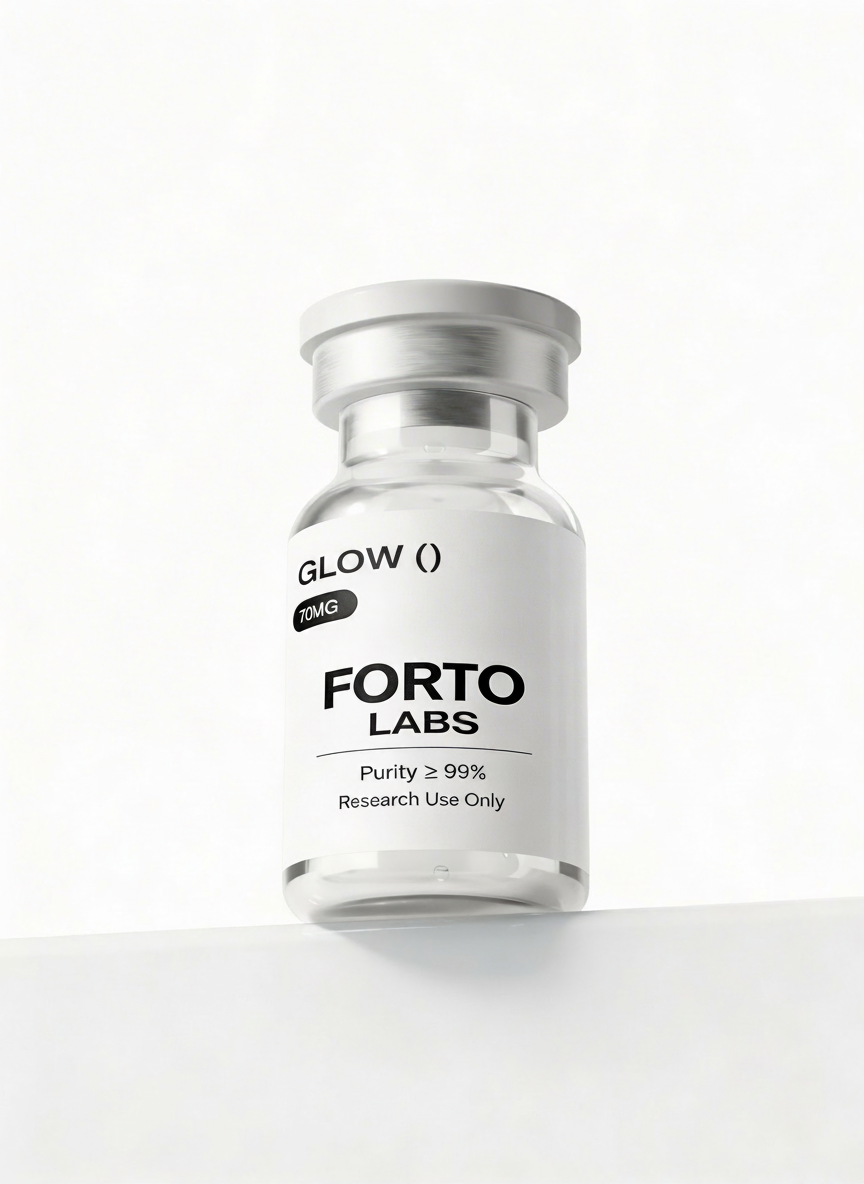
Key Statistics
| Statistic | Value | Detail |
|---|---|---|
| Pathways | 3 | VEGF + Actin + Collagen synergy |
| GHR Upregulation | 7× | BPC-157 by day 3 |
| Collagen Increase | 70% | GHK-Cu vs vitamin C (50%) |
| Faster Healing | 61% | TB-500 re-epithelialization |
| Combined Studies | 500+ | Across all three peptides |
Mechanism of Action
Three Pathways, One Formula
GLOW combines three well-researched peptides that target distinct but complementary regenerative mechanisms. BPC-157 promotes angiogenesis through VEGF pathways, TB-500 enhances cell migration via actin regulation, and GHK-Cu stimulates collagen synthesis and gene expression. Together, they address tissue repair at multiple biological levels.
Biological Pathways
VEGF Pathway (Primary)
Vascular Endothelial Growth Factor (BPC-157)
- Promotes blood vessel formation
- Enhances tissue granulation
- Modulates nitric oxide signaling
Actin Regulation (Primary)
Thymosin Beta-4 Pathway (TB-500)
- Increases cell migration
- Supports cytoskeletal remodeling
- Reduces fibrotic scarring
Collagen & ECM (Primary)
Copper Peptide Signaling (GHK-Cu)
- Stimulates type I & III collagen
- Modulates 4,000+ genes
- Delivers copper to cells
Key Mechanism
Complementary Regeneration
Each peptide addresses a different phase of tissue repair. BPC-157 initiates vascular support. TB-500 mobilizes repair cells through enhanced migration. GHK-Cu provides the collagen framework and gene activation for structural rebuilding.
Source: MDPI Review
| Metric | Value |
|---|---|
| GHK-Cu Collagen | 70% |
| TB-500 Healing | 61% |
| BPC-157 GHR | 700% |
| Combined publications | 500+ |
Clinical Findings
| Metric | Value | Context |
|---|---|---|
| Increased Collagen in Wounds | 9× improvement | GHK-Cu with PIC treatment |
| GHR Upregulation by Day 3 | 7× improvement | BPC-157 in tendon fibroblasts |
| Faster Re-epithelialization | 61% | TB-500 vs controls at 7 days |
Data aggregated from individual peptide studies. BPC-157: 200+ studies, TB-500: 170+ studies, GHK-Cu: 130+ studies. Combination research is emerging.
Preclinical Effects
| Effect | Model | Value |
|---|---|---|
| Collagen Synthesis (GHK-Cu) | Skin studies | ↑ 70% |
| Gene Modulation (GHK-Cu) | Human genome | 4,000+ genes |
| TB-500 Cell Migration | Motility assay | +85% |
| BPC-157 Angiogenesis | Ischemic tissue | +80% |
Research Areas
Skin Regeneration — Dermal remodeling and wound closure
GHK-Cu promotes collagen synthesis while BPC-157 and TB-500 support epithelial repair and reduce scarring
Source: Pickart & Margolina (2018)
Tissue Repair — Multi-pathway musculoskeletal healing
TB-500 facilitates actin remodeling; BPC-157 promotes tendon fibroblast viability; GHK-Cu supports vascularization
Source: Chi et al. (2017)
Anti-Inflammatory — Triple anti-inflammatory coverage
All three peptides modulate inflammatory mediators through different mechanisms
Source: Hsieh et al. (2016)
ECM Remodeling — Extracellular matrix restoration
Coordinated ECM deposition for functional, less fibrotic tissue regeneration
Source: Brcic et al. (2011)
Dosing Protocols
Individual Component Protocols
Dose: BPC: 200-500mcg / TB4: 2-5mg / GHK-Cu: 1-2mg | Frequency: BPC: 1-2x daily / TB4: 2x weekly / GHK-Cu: daily | Duration: Varies by study
- Doses from individual peptide studies
- Actual blend ratios may vary
- Research protocols designed per specific models
Topical GHK-Cu Protocol
Dose: 2-4% concentration cream/serum | Frequency: 2x daily | Duration: 12 weeks
- Most commonly studied delivery method for GHK-Cu
- Results typically visible after 4-6 weeks
- Can be combined with injectable protocols
Pharmacokinetics
| Parameter | Value |
|---|---|
| Half-Life | BPC: <30min / TB: ~1hr / GHK-Cu: 30-60min |
| Peak Concentration | Component-dependent |
| Bioavailability | BPC: gastric stable / TB: systemic / GHK-Cu: topical & injectable |
| Stability | Reconstituted: refrigerate, use within days |
| Excretion | Standard peptide degradation |
| Metabolism | Each component has different PK profiles |
Safety Profile
| Issue | Incidence | Severity |
|---|---|---|
| Injection site reactions | 10% | mild |
| No systemic toxicity | 0% | mild |
- BPC-157: No LD50 found in preclinical studies
- TB-500: Well-tolerated in animal studies
- GHK-Cu: Safe topical use history since 1980s
- Combination safety requires specific investigation
Compound Information
| Property | Value |
|---|---|
| Type | Triple peptide blend |
| CAS Number | BPC: 137525-51-0 / TB: 77591-33-4 / GHK-Cu: 89030-95-5 |
| Molecular Weight | BPC: 1,419 Da / TB: 4,963 Da / GHK-Cu: 403 Da |
| Amino Acids | BPC: 15 / TB: 43 / GHK-Cu: 3 + Cu²⁺ |
| Sequence | Three distinct compounds with complementary pathways |
| Formula | BPC + TB-500 + GHK-Cu blend |
Frequently Asked Questions
Q: What is GLOW and what does it contain?
A: GLOW is a triple-peptide blend containing BPC-157 (15-amino acid gastric peptide), TB-500 (43-amino acid thymosin beta-4 fragment), and GHK-Cu (copper tripeptide). Each targets different but complementary regenerative mechanisms.
Q: How does GLOW differ from the Wolverine Stack?
A: The Wolverine Stack contains only BPC-157 and TB-500. GLOW adds GHK-Cu, which brings collagen synthesis, gene modulation (4,000+ genes), and copper delivery mechanisms, extending applications to skin regeneration and anti-aging pathways.
Q: What research has been done on these peptides?
A: Individually: BPC-157 has 200+ publications, TB-500 has 170+, and GHK-Cu has 130+. Combination research is emerging but less extensive.
Q: Is GLOW approved for human use?
A: No. BPC-157 and TB-500 are investigational peptides banned by WADA. GHK-Cu is used in cosmetics but not approved as a therapeutic. GLOW is intended for research applications only.
Q: What is the mechanism of synergy in GLOW?
A: 1) Angiogenesis — BPC-157 (VEGF) and GHK-Cu (capillary growth); 2) Cell migration — TB-500 (actin regulation); 3) ECM remodeling — GHK-Cu (collagen) while TB-500 reduces fibrosis; 4) Anti-inflammatory — all three modulate inflammation differently.
References
- Tydes Research (2025) “GLOW Peptide Blend: GHK-Cu, TB-500, and BPC-157 in Regenerative Research” Tydes Research
- Pickart L, Margolina A (2018) “Regenerative and Protective Actions of the GHK-Cu Peptide” International Journal of Molecular Sciences DOI: 10.3390/ijms19071987 PMID: 29986520
- Seiwerth S, et al. (2018) “BPC 157 and Standard Angiogenic Growth Factors” Current Pharmaceutical Design PMID: 30101703
- Gwyer D, et al. (2019) “BPC 157 and Musculoskeletal Soft Tissue Healing” Cell and Tissue Research PMID: 30915550
- Malinda KM, et al. (1999) “Thymosin Beta-4 Accelerates Wound Healing” Journal of Investigative Dermatology PMID: 10594747