
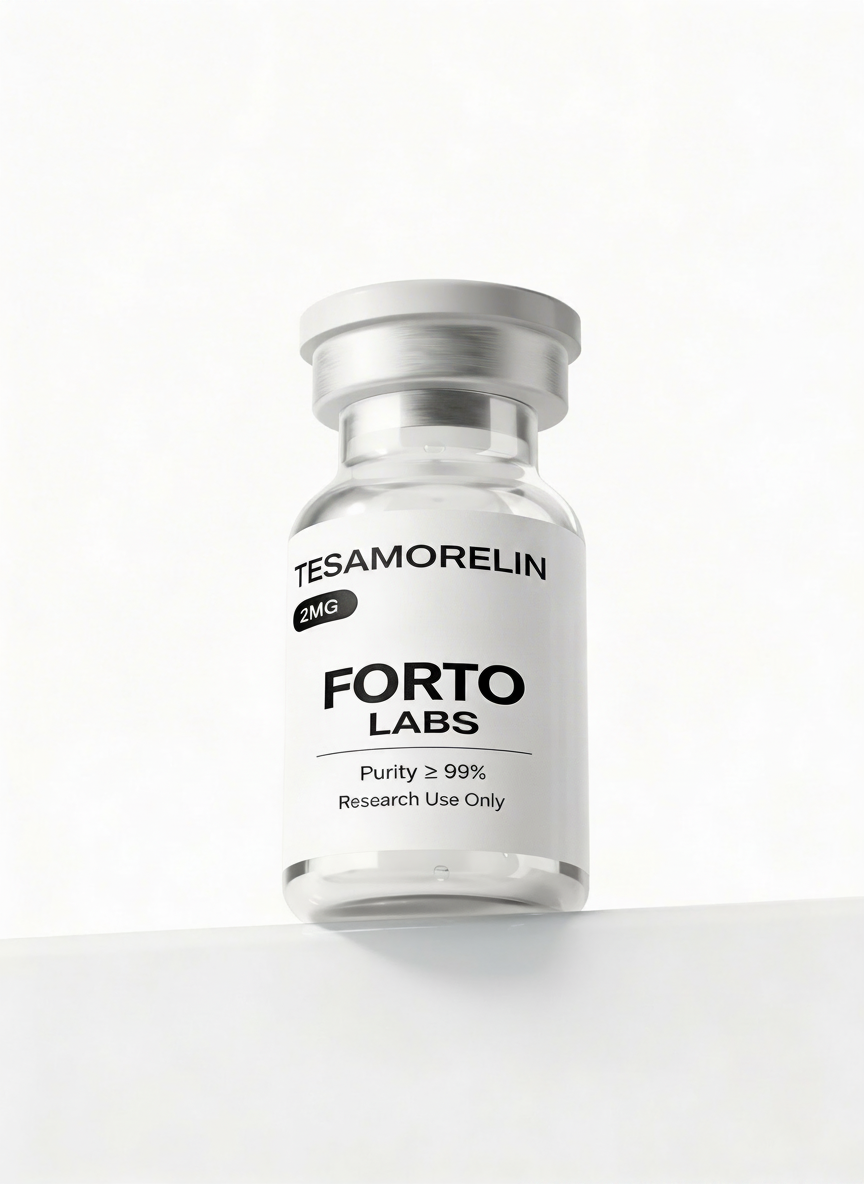
Key Statistics
| Statistic | Value | Detail |
|---|---|---|
| Visceral Fat Reduction | 18.2% | Abdominal fat loss at 26 weeks |
| IGF-1 Increase | 117% | Growth factor elevation |
| Liver Fat Reduction | 37% | NAFLD improvement at 12 months |
| NAFLD Resolution | 35% | Complete fatty liver reversal |
| Executive Function | P=0.005 | Significant cognitive improvement |
Mechanism of Action
GHRH Receptor-Mediated GH Release
Tesamorelin binds to GHRH receptors on pituitary somatotrophs, stimulating pulsatile GH release that maintains physiological feedback mechanisms and circadian rhythms. It promotes selective lipolysis in visceral adipose tissue while preserving subcutaneous fat and muscle mass.
Biological Pathways
GHRH Receptor Activation (Primary)
Growth Hormone Releasing Hormone
- Binds pituitary somatotrophs
- Stimulates pulsatile GH release
- Maintains physiological feedback
IGF-1 Mediated Lipolysis (Mediator)
Insulin-like Growth Factor 1
- Stimulates hepatic IGF-1 production
- Promotes selective visceral lipolysis
- Preserves muscle mass
Metabolic Modulation (Supportive)
Metabolic Flexibility Enhancement
- Reduces ectopic fat deposition
- Improves insulin sensitivity
- Enhances metabolic flexibility
Key Mechanism
Pulsatile GH Stimulation
Tesamorelin preserves natural GH pulsatility unlike exogenous growth hormone. It stimulates the body’s own GH production, maintaining circadian rhythms and feedback mechanisms for a physiologically superior approach.
Source: JCEM (2010)
| Metric | Value |
|---|---|
| VAT Reduction (26wk) | 15.4% |
| VAT Reduction (52wk) | 17.5% |
| Placebo Change | -5% |
| Participants Achieving >8% VAT Reduction | 73% |
Clinical Findings
| Metric | Value | Context |
|---|---|---|
| Visceral Fat Reduction | 18.2% | Phase 3, 816 patients, 26 weeks |
| IGF-1 Increase | 117% | Mean elevation from baseline |
| Liver Fat Reduction | 37% | MRI-PDFF measurement |
FDA-approved for HIV-associated lipodystrophy. Results from two Phase 3 trials (LIPO-010 & CTR-1011) with 816 HIV-infected patients.
Preclinical Effects
| Effect | Model | Value |
|---|---|---|
| Treatment Well Tolerated | Phase 3 trials | 91.2% |
| Effects Maintained | Continued use | 52 weeks |
| Triglyceride Reduction | VAT responders | 20-50 mg/dL |
| Trunk Muscle Density | Body composition | +4.86 HU |
Research Areas
Visceral Fat Reduction — Primary FDA-approved indication
18.2% average VAT reduction at 26 weeks in HIV lipodystrophy patients
Source: JCEM (2010)
Liver Health — NAFLD/NASH treatment potential
37% hepatic fat reduction, 35% NAFLD resolution. Only FDA-approved agent for HIV-associated NAFLD
Source: Lancet HIV (2019)
Cognitive Function — Executive function improvement
Significant improvements in executive function (P=0.005) and response inhibition in older adults
Source: Archives of Neurology (2012)
Body Composition — Muscle quality enhancement
Improvements in muscle density and lean mass area without loss of lean tissue
Source: JCEM (2019)
Dosing Protocols
Standard FDA Protocol
Dose: 2mg daily subcutaneous | Frequency: Once daily | Duration: Continuous (effects reverse on discontinuation)
- Inject in abdomen, rotate sites
- Same time each day recommended
- Effects reverse if discontinued
Cognitive Support Protocol
Dose: 1mg daily | Frequency: 30 min before bedtime | Duration: 20+ weeks, then assess response
- Lower dose than standard lipodystrophy protocol
- Bedtime administration studied
- Based on MCI/aging study
Pharmacokinetics
| Parameter | Value |
|---|---|
| Half-Life | 26-38 minutes |
| Peak Concentration | 0.15 hours (9 minutes) |
| Bioavailability | <4% (typical for peptides) |
| Stability | Requires reconstitution |
| Excretion | Renal (peptide fragments) |
| Metabolism | Peptide hydrolysis |
Safety Profile
| Issue | Incidence | Severity |
|---|---|---|
| Injection site reactions | 13.3% | mild |
| Arthralgia | 7.5% | mild |
| Peripheral edema | 5.7% | mild |
- Generally well-tolerated with predictable GH-related side effects
- Anti-tesamorlin antibodies detected but no impact on efficacy
- Well-tolerated long-term (52+ weeks)
Compound Information
| Property | Value |
|---|---|
| Type | Synthetic GHRH analog |
| CAS Number | 218949-48-5 |
| Molecular Weight | 5,135.9 g/mol |
| Amino Acids | 44 |
| Sequence | Modified GHRH(1-44) |
| Formula | C221H366N72O67S1 |
Frequently Asked Questions
Q: How long does it take to see results?
A: IGF-1 levels increase within 2-4 weeks. Visible reduction in abdominal fat typically begins around 8-12 weeks, with maximal effects at 26 weeks. Clinical trials show 15-18% visceral fat reduction at 6 months.
Q: What happens if I stop taking Tesamorelin?
A: Effects are not sustained after discontinuation. Clinical studies show visceral fat returns to near baseline levels within 26 weeks of stopping treatment.
Q: Is Tesamorelin the same as HGH?
A: No. Tesamorelin stimulates your body’s own growth hormone production while preserving natural pulsatility and feedback mechanisms, which is physiologically superior to exogenous HGH.
Q: Can Tesamorelin improve cognitive function?
A: Research shows promising cognitive benefits. A controlled trial demonstrated significant improvements in executive function (P=0.005) in both healthy older adults and those with mild cognitive impairment, using 1mg daily.
References
- Falutz J, et al. (2010) “Effects of tesamorelin in HIV-infected patients with abdominal fat accumulation” Journal of Clinical Endocrinology & Metabolism PMID: 20554713
- Stanley TL, et al. (2019) “Effects of tesamorelin on non-alcoholic fatty liver disease in HIV” Lancet HIV PMID: 31611038
- Baker LD, et al. (2012) “Effects of GHRH on cognitive function in adults with MCI and healthy older adults” Archives of Neurology PMID: 22869065
- Adrian S, et al. (2019) “Tesamorelin Decreases Muscle Fat and Increases Muscle Area in Adults with HIV” Journal of Clinical Endocrinology and Metabolism PMID: 31050749
- Fourman LT, et al. (2020) “Effects of tesamorelin on hepatic transcriptomic signatures in HIV-associated NAFLD” JCI Insight PMID: 32780726
- Theratechnologies Inc. (2025) “Tesamorelin Prescribing Information” EGRIFTA Prescribing Information