
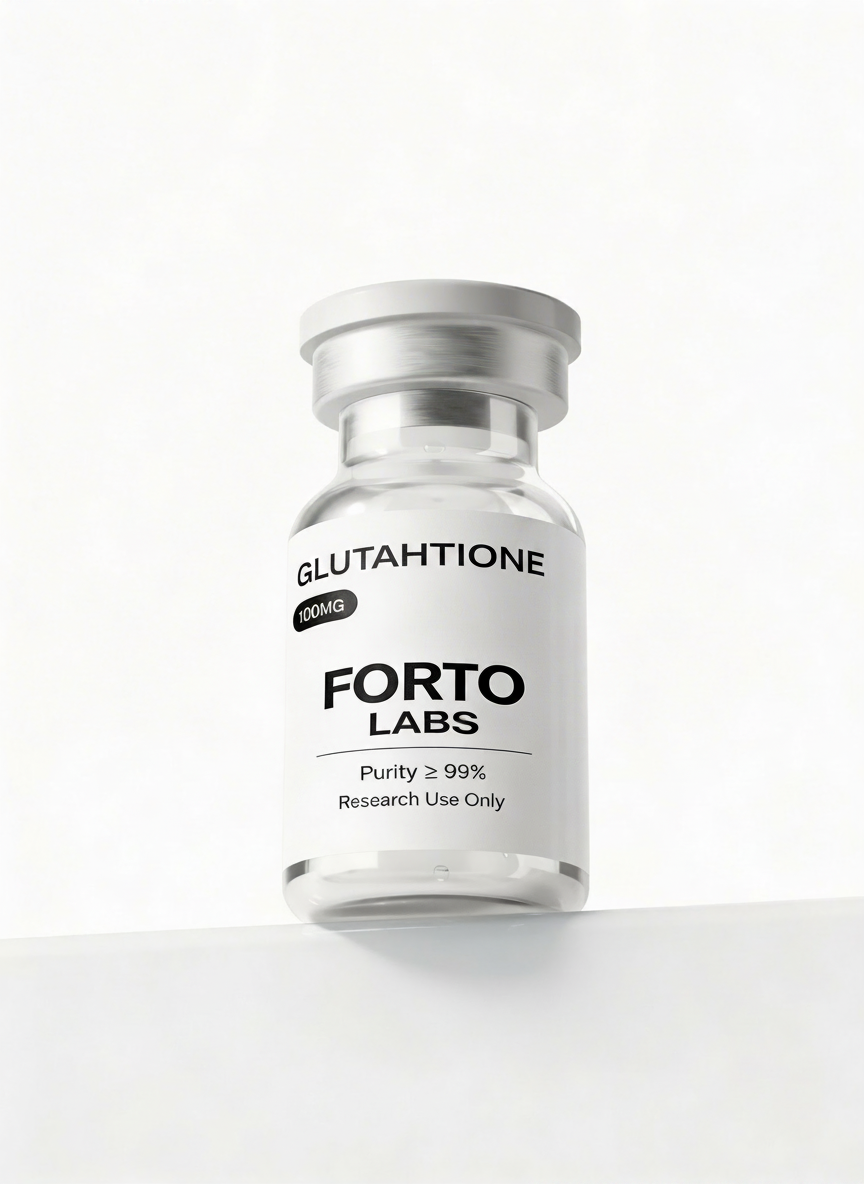
Key Statistics
| Statistic | Value | Detail |
|---|---|---|
| GSH Increase | 35% | 6-month RCT, high-dose |
| NK Cell Activity | 2× | Immune function boost |
| Cellular Processes | 500+ | Essential cofactor |
| Amino Acids | 3 | Tripeptide (Glu-Cys-Gly) |
| Landmark RCT | 54 | 6-month clinical trial subjects |
Mechanism of Action
The Body’s Master Antioxidant
Glutathione works through three interconnected mechanisms: (1) Antioxidant Defense — directly scavenges free radicals and ROS via glutathione peroxidase; (2) Phase II Detoxification — GSTs conjugate GSH to toxins for elimination; (3) Redox Regulation — maintains cellular redox balance by cycling between reduced (GSH) and oxidized (GSSG) forms.
Biological Pathways
Antioxidant Defense (Primary)
Glutathione Peroxidase System
- Neutralizes H2O2 and lipid peroxides
- Protects cell membranes and DNA
- Regenerates vitamins C and E
Phase II Detox (Primary)
Glutathione S-Transferase
- Conjugates toxins for elimination
- Removes drugs and carcinogens
- Primary cellular detox mechanism
Redox Balance (Primary)
GSH/GSSG Cycling
- Maintains cellular redox state
- GSH/GSSG ratio = health indicator
- Supports optimal cell function
Key Mechanism
Clinical Evidence: Oral GSH Bioavailability
The landmark 6-month RCT by Richie et al. (2015) was the first to demonstrate that daily oral GSH supplements effectively increase body compartment stores of glutathione in humans. Effects were dose-dependent and returned to baseline after washout.
Source: Richie et al., Eur J Nutr 2015
| Metric | Value |
|---|---|
| Buccal Cell GSH | +260% |
| Lymphocyte GSH | +35% |
| Erythrocyte GSH | +35% |
| Plasma GSH | +30% |
Clinical Findings
| Metric | Value | Context |
|---|---|---|
| Blood GSH Increase | 35% | High dose (1000mg/day), 6 months |
| NK Cell Cytotoxicity | 2× | More than doubled at 3 months |
| Buccal Cell GSH | +260% | Highest tissue increase |
100% of participants completed the 6-month trial with no dropouts due to side effects. Both 250mg and 1000mg doses were effective, with higher dose showing greater and faster increases.
Preclinical Effects
| Effect | Model | Value |
|---|---|---|
| Immune Boost | NK cell cytotoxicity | 2× |
| Tissue GSH | Buccal cells | +260% |
| Liver Support | NAFLD patients | ALT↓ |
| Skin Melanin | Multiple body sites | ↓ |
Research Areas
Antioxidant Defense — Oxidative Stress Protection
Primary water-soluble antioxidant that directly neutralizes free radicals and regenerates vitamins C and E.
Source: Richie et al. 2015
Immune Function — NK Cell Support
GSH supplementation significantly enhanced NK cell cytotoxicity (>2× increase), a key marker of innate immune function.
Source: Richie et al. 2015
Metabolic Health — Insulin Sensitivity
Oral GSH improved whole-body insulin sensitivity in obese subjects with and without type 2 diabetes over 3 weeks.
Source: Søndergård et al. 2021
Skin Appearance — Melanin Reduction
Oral GSH (500mg/day for 4 weeks) decreased melanin indices at all six measured body sites in a placebo-controlled trial.
Source: Arjinpathana & Asawanonda 2012
Dosing Protocols
Oral (Standard)
Dose: 250-500 mg | Frequency: Once or twice daily | Duration: 1-6+ months
- Take on empty stomach
- Effects accumulate over time
- Consider liposomal forms for enhanced absorption
- Benefits return to baseline within 1 month of stopping
Oral (High Dose)
Dose: 1000 mg | Frequency: Divided doses | Duration: 6+ months
- Greater and faster increases in tissue GSH
- Used in landmark RCT
- Both doses effective
IV Protocol (Clinical)
Dose: 600-1200 mg | Frequency: Weekly to monthly | Duration: As directed
- 100% bioavailability
- Must be administered by qualified providers
- FDA has noted safety concerns with compounded IV GSH
Pharmacokinetics
| Parameter | Value |
|---|---|
| Half-Life | Variable (endogenous turnover) |
| Peak Concentration | Dose-dependent tissue accumulation |
| Bioavailability | Variable oral; enhanced by liposomal; 100% IV |
| Stability | Sensitive to light and temperature |
| Excretion | Metabolized in all cells |
| Metabolism | GSH/GSSG cycling; intracellular concentration 1-10 mM |
Safety Profile
| Issue | Incidence | Severity |
|---|---|---|
| GI discomfort | 5% | Mild |
| Bloating | 3% | Mild |
| Headache | 2% | Mild |
- 100% trial completion rate across major studies (no dropouts)
- Both 250mg and 1000mg doses well tolerated for 6 months
- No serious adverse events reported with oral GSH
- Oral supplementation has excellent safety record in trials
Compound Information
| Property | Value |
|---|---|
| Type | Endogenous antioxidant tripeptide |
| CAS Number | 70-18-8 |
| Molecular Weight | 307.32 g/mol |
| Amino Acids | 3 |
| Sequence | γ-L-Glutamyl-L-cysteinyl-glycine |
| Formula | C10H17N3O6S |
Frequently Asked Questions
Q: What is glutathione and why is it called the ‘master antioxidant’?
A: Glutathione (GSH) is a tripeptide found in every cell. It directly neutralizes free radicals, regenerates vitamins C and E, and participates in over 500 enzymatic reactions including the body’s primary detoxification systems.
Q: Does oral glutathione actually get absorbed?
A: Yes. A landmark 6-month RCT showed oral GSH (250-1000mg daily) significantly increased GSH levels in blood, erythrocytes, plasma, lymphocytes, and buccal cells (up to +260%). This confirmed oral bioavailability in humans.
Q: What are the proven benefits?
A: Clinical trials show: 30-260% increased tissue GSH stores, >2× NK cell cytotoxicity, improved insulin sensitivity in obese subjects, reduced skin melanin indices, and decreased liver enzymes (ALT) in NAFLD patients.
Q: How much should be taken?
A: Clinical trials used 250-1000mg daily. The 1000mg dose produced greater and faster increases. Benefits accumulate over 1-6 months and return to baseline within 1 month of stopping.
Q: Is glutathione safe?
A: Oral GSH has an excellent safety profile in trials up to 6 months with 100% completion rate and no dropouts due to adverse effects. However, IV glutathione has different safety considerations with FDA-flagged concerns.
References
- Richie JP Jr, Nichenametla S, Neidig W, et al. (2015) “Randomized controlled trial of oral glutathione supplementation on body stores” European Journal of Nutrition DOI: 10.1007/s00394-014-0706-z PMID: 24791752
- Arjinpathana N, Asawanonda P (2012) “Glutathione as an oral whitening agent: a randomized, double-blind, placebo-controlled study” Journal of Dermatological Treatment DOI: 10.3109/09546631003801619 PMID: 20524875
- Søndergård SD, Cintin I, et al. (2021) “Effects of 3 weeks of oral glutathione on insulin sensitivity in obese males” Applied Physiology, Nutrition, and Metabolism DOI: 10.1139/apnm-2020-1099 PMID: 33740389
- Honda Y, Kessoku T, et al. (2017) “Efficacy of glutathione for NAFLD: open-label pilot study” BMC Gastroenterology DOI: 10.1186/s12876-017-0652-3 PMID: 28789631
- Wu G, Fang YZ, Yang S, et al. (2004) “Glutathione metabolism and its implications for health” Journal of Nutrition PMID: 15044610