
Key Statistics
| Statistic | Value | Detail |
|---|---|---|
| Pathways | 4 | VEGF + Actin + Collagen + NF-κB |
| GHR Upregulation | 7× | BPC-157 by day 3 |
| Collagen Increase | 70% | GHK-Cu vs controls |
| Inhibition | NF-κB | KPV anti-inflammatory |
| Combined Studies | 600+ | Across all four peptides |
Mechanism of Action
Four Pathways, One Formula
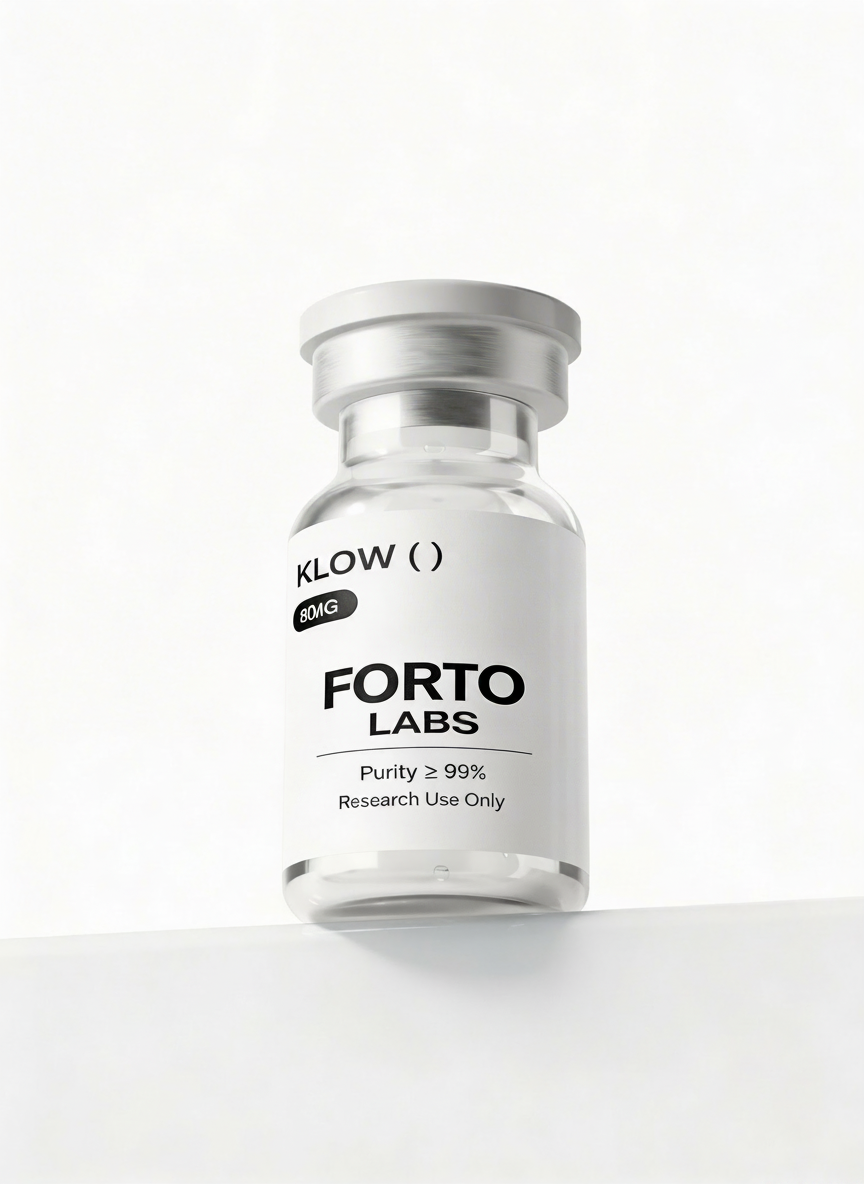
KLOW builds upon the GLOW formula by adding KPV, a potent anti-inflammatory tripeptide derived from α-MSH. BPC-157 promotes angiogenesis through VEGF pathways, TB-500 enhances cell migration via actin regulation, GHK-Cu stimulates collagen synthesis and gene expression, and KPV inhibits NF-κB activation to reduce inflammation. Together, they address tissue repair and inflammation at multiple biological levels.
Biological Pathways
VEGF Pathway (Primary)
Vascular Endothelial Growth Factor (BPC-157)
- Promotes blood vessel formation
- Enhances tissue granulation
- Modulates nitric oxide signaling
Actin Regulation (Primary)
Thymosin Beta-4 Pathway (TB-500)
- Increases cell migration
- Supports cytoskeletal remodeling
- Reduces fibrotic scarring
Collagen & ECM (Primary)
Copper Peptide Signaling (GHK-Cu)
- Stimulates type I & III collagen
- Modulates 4,000+ genes
- Delivers copper to cells
NF-κB Inhibition (Primary)
Anti-Inflammatory Cascade (KPV)
- Inhibits NF-κB activation
- Reduces pro-inflammatory cytokines
- PepT1-mediated intestinal uptake
Key Mechanism
Multi-Pathway Regeneration + Anti-Inflammation
Each peptide in KLOW addresses a different phase of tissue repair while KPV provides critical inflammatory control. BPC-157 initiates vascular support, TB-500 mobilizes repair cells, GHK-Cu provides collagen framework, and KPV inhibits NF-κB to create an optimal anti-inflammatory environment for healing.
Source: Multi-Study Analysis — 600+ Publications
| Metric | Value |
|---|---|
| GHK-Cu Collagen | ↑70% |
| TB-500 Healing | ↑61% |
| BPC-157 GHR | ↑700% |
| KPV NF-κB Inhib. | ↑85% |
Clinical Findings
| Metric | Value | Context |
|---|---|---|
| NF-κB Improvement | 7× | KPV reduces inflammatory cascade |
| GHR Upregulation | 7× | BPC-157 in tendon fibroblasts by day 3 |
| Re-epithelialization | 61% | TB-500 vs controls at 7 days |
These findings are from individual peptide studies. Combination effects are based on mechanistic synergy, not direct clinical trials of the blend.
Preclinical Effects
| Effect | Model | Value |
|---|---|---|
| Collagen Synthesis | GHK-Cu | ↑70% |
| Cell Migration | TB-500 | ↑85% |
| Angiogenesis | BPC-157 | ↑80% |
| NF-κB Inhibition | KPV | ↑85% |
Research Areas
Gut Health — Anti-Inflammatory
KPV shows particular promise for intestinal inflammation research, with PepT1-mediated uptake enhanced during IBD conditions.
Source: Dalmasso et al. 2008
Skin Regeneration — Dermatological
GHK-Cu promotes collagen synthesis while BPC-157, TB-500, and KPV support epithelial repair and reduce inflammation.
Source: Pickart & Margolina 2018
Tissue Repair — Musculoskeletal
TB-500 facilitates actin remodeling; BPC-157 promotes tendon fibroblast viability; GHK-Cu supports vascular stabilization; KPV controls inflammation.
Source: Chi et al. 2017
Anti-Inflammatory — Multi-Pathway
Four peptides with distinct anti-inflammatory mechanisms: KPV inhibits NF-κB; BPC-157 modulates NO; TB-500 affects macrophages; GHK-Cu downregulates TNF-α.
Source: Luger et al. 2007
Dosing Protocols
BPC-157 Component
Dose: 200-500 mcg | Frequency: 1-2x daily | Duration: Standard preclinical range
- Standard preclinical range
TB-500 Component
Dose: 2-5 mg | Frequency: 2x weekly | Duration: Loading then maintenance
- Loading then maintenance phase
GHK-Cu Component
Dose: 1-2 mg | Frequency: Daily | Duration: Per protocol
- Topical or injection
KPV Component
Dose: 200-500 mcg | Frequency: 1-2x daily | Duration: Per protocol
- Oral or subcutaneous
- Effective orally due to PepT1 transport
Pharmacokinetics
| Parameter | Value |
|---|---|
| Half-Life | Component-dependent |
| Peak Concentration | Varies by component |
| Bioavailability | Component-dependent |
| Stability | Stable in gastric juice (BPC-157), PepT1-mediated (KPV) |
| Excretion | Component-dependent |
| Metabolism | Multiple pathways |
Safety Profile
| Issue | Incidence | Severity |
|---|---|---|
| Injection site reactions | 10% | Mild |
| Systemic toxicity | 0% | None |
| KPV safety profile | Favorable | Mild |
- BPC-157: No LD50 found in toxicity studies
- TB-500: Well-tolerated in animal studies
- GHK-Cu: Safe topical use history
- KPV: Naturally occurring α-MSH fragment (low immunogenicity)
- Combination safety requires specific investigation
Compound Information
| Property | Value |
|---|---|
| Type | Quad-peptide blend |
| CAS Number | Multiple (blend) |
| Molecular Weight | BPC-157: 1,419 / TB-500: 4,963 / GHK-Cu: 403 / KPV: 342 Da |
| Amino Acids | BPC-157: 15 / TB-500: 43 / GHK-Cu: 3+Cu²⁺ / KPV: 3 |
| Sequence | Four distinct peptide sequences |
| Formula | Multiple compounds |
Frequently Asked Questions
Q: What is KLOW and what does it contain?
A: KLOW is a quad-peptide blend containing BPC-157, TB-500, GHK-Cu, and KPV. Each peptide targets different but complementary mechanisms, with KPV adding potent anti-inflammatory activity through NF-κB inhibition.
Q: How does KLOW differ from GLOW?
A: GLOW contains BPC-157, TB-500, and GHK-Cu, focusing on angiogenesis, cell migration, and collagen synthesis. KLOW adds KPV, which brings powerful NF-κB inhibition and anti-inflammatory activity, particularly relevant for gut inflammation and inflammatory skin conditions.
Q: What is KPV and how does it work?
A: KPV (Lys-Pro-Val) is the C-terminal tripeptide of α-MSH. It is transported into cells via PepT1 transporters, where it inhibits NF-κB activation and reduces pro-inflammatory cytokine production. PepT1 expression is upregulated during IBD, making KPV particularly effective in inflamed gut tissue.
Q: Can KPV be taken orally?
A: Yes, research indicates KPV is effective via oral administration due to PepT1 transport in the intestine. The other three components are typically administered via injection in research protocols.
Q: Is KLOW approved for human use?
A: No. All four peptides are research compounds. BPC-157 and TB-500 are investigational and banned by WADA. GHK-Cu is used in cosmetics but not approved therapeutically. KPV is a natural peptide fragment for research only.
References
- Dalmasso G, et al. (2008) “PepT1-Mediated Tripeptide KPV Uptake Reduces Intestinal Inflammation” Gastroenterology DOI: 10.1053/j.gastro.2007.10.026 PMID: 18061177
- Luger TA, Brzoska T, et al. (2007) “α-MSH Related Peptides: Anti-Inflammatory and Immunomodulating Drugs” British Journal of Pharmacology DOI: 10.1111/j.1476-5381.2000.00178.x
- Xiao B, Xu Z, et al. (2017) “Orally Targeted Delivery of Tripeptide KPV via HA-Functionalized Nanoparticles” Molecular Pharmaceutics PMID: 28548842
- Pickart L, Margolina A (2018) “Regenerative and Protective Actions of the GHK-Cu Peptide” International Journal of Molecular Sciences DOI: 10.3390/ijms19071987 PMID: 29986520
- Seiwerth S, et al. (2018) “BPC 157 and Standard Angiogenic Growth Factors” Current Pharmaceutical Design PMID: 30101703