
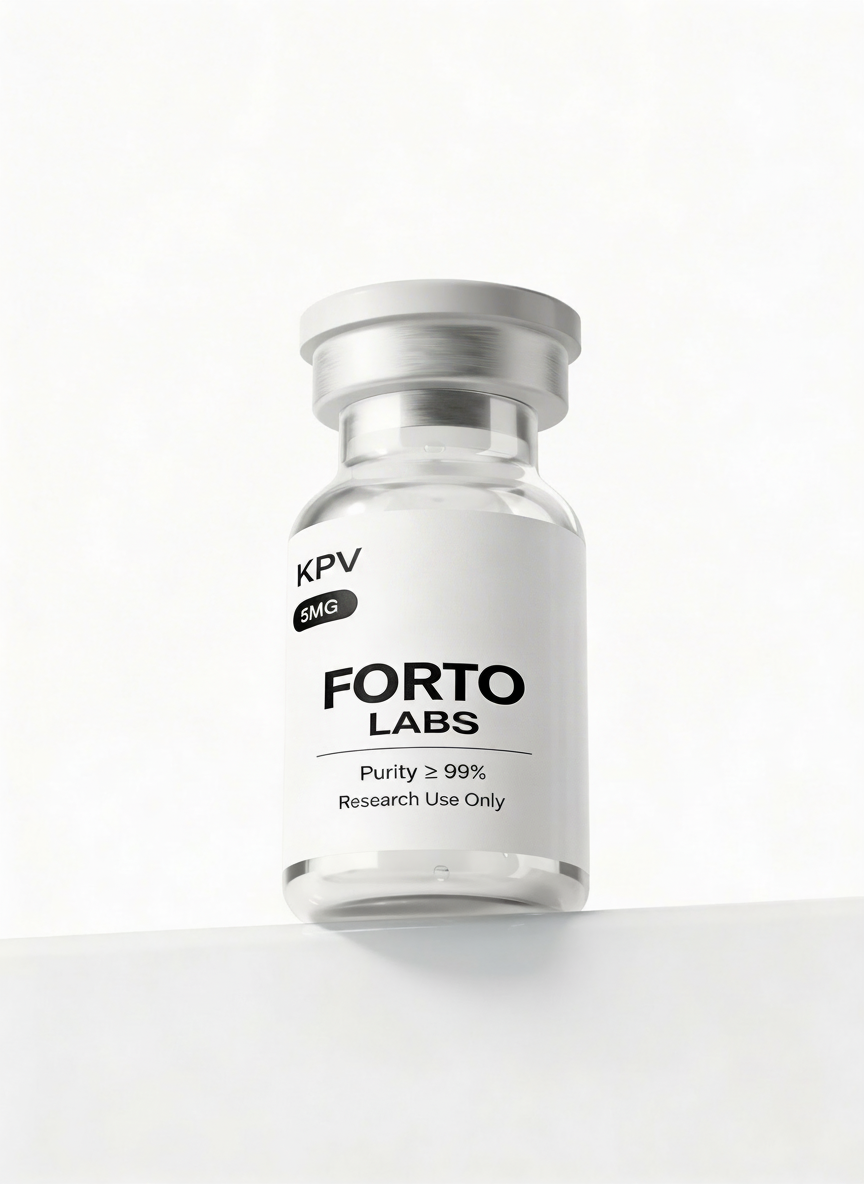
Key Statistics
| Statistic | Value | Detail |
|---|---|---|
| MPO Reduction | 50% | DSS colitis model |
| IL-8 Decrease | 35% | Inflammatory cytokine |
| Effective Dose | 10nM | In vitro concentration |
| Transport | PepT1 | Not MCR-mediated |
| Publications | 100+ | α-MSH peptide research |
Mechanism of Action
NF-κB Inhibition via PepT1 Transport
KPV is the C-terminal tripeptide of alpha-melanocyte-stimulating hormone (α-MSH) that retains potent anti-inflammatory activity. Unlike full-length α-MSH which works through melanocortin receptors, KPV enters cells via the PepT1 di/tripeptide transporter. Once inside, it inhibits NF-κB and MAPK inflammatory signaling pathways at nanomolar concentrations, reducing pro-inflammatory cytokine production.
Biological Pathways
PepT1 Transport (Primary)
Peptide Transporter 1 (SLC15A1)
- High-affinity cellular uptake
- Enhanced expression during IBD
- Enables oral bioavailability
NF-κB Pathway (Primary)
Nuclear Factor Kappa-B Inhibition
- Shortens NF-κB activation duration
- Interacts with IκB-α and p65RelA
- Nuclear import inhibition
MAPK Pathway (Secondary)
Mitogen-Activated Protein Kinase
- Reduces ERK phosphorylation
- Decreases inflammatory signaling
- Synergizes with NF-κB inhibition
Key Mechanism
NOT Melanocortin Receptor-Mediated
KPV’s anti-inflammatory effects are NOT mediated by melanocortin receptors (MC1R-MC5R). KPV does not bind to MC-1R and fails to increase cAMP levels. Instead, it is transported directly into cells by PepT1, where it accumulates in the nucleus to inhibit NF-κB activation.
Source: Gastroenterology — Dalmasso et al. 2008
| Metric | Value |
|---|---|
| NF-κB Inhibition | 83% |
| MPO Reduction (DSS) | 50% |
| IL-8 mRNA Reduction | 35% |
| MAPK Suppression | 60% |
Clinical Findings
| Metric | Value | Context |
|---|---|---|
| NF-κB Activation Reduced | 6× | IL-1β stimulated cells + KPV |
| MPO Activity Decrease | 50% | DSS-induced colitis model |
| IL-8 mRNA Reduction | 35% | Intestinal epithelial cells |
Study design: C57BL/6 mice (n=10 per group), 8 weeks old, treated with 100 μM KPV in drinking water. DSS model: 8 days; TNBS model: assessed at 48 hours.
Preclinical Effects
| Effect | Model | Value |
|---|---|---|
| MPO (DSS) | Mouse colitis | -50% |
| MPO (TNBS) | Mouse colitis | -30% |
| Effective Conc. | In vitro | 10nM |
| Oral Bioavail. | PepT1-mediated | Yes |
Research Areas
IBD Research — Primary Focus
Ulcerative colitis and Crohn’s disease models with PepT1-mediated targeting to inflamed intestinal tissue
Source: Dalmasso et al. 2008
Skin Inflammation — Dermatological
Contact dermatitis, cutaneous vasculitis, and wound healing models; topical application shows efficacy
Source: Luger et al. 2007
Anti-Microbial — Pathogen Inhibition
KPV exhibits antimicrobial activity against Staphylococcus aureus and Candida albicans pathogens
Source: Br J Pharmacol 2000
Arthritis Models — Joint Inflammation
α-MSH peptides showed efficacy comparable to prednisolone without causing weight loss in adjuvant-induced arthritis
Source: Luger et al. 2007
Dosing Protocols
In Vitro
Dose: 10 nM | Frequency: Cell culture | Duration: As needed
- Effective in vitro concentration
- Nanomolar concentrations effective in cell culture
Oral (Animal)
Dose: 100 μM | Frequency: In drinking water | Duration: 8 days (DSS model)
- Mouse colitis models
- PepT1 transport is viable
- Human dosing not established
Subcutaneous
Dose: 200-500 mcg | Frequency: 1-2x daily | Duration: Per protocol
- Extrapolated from α-MSH studies
- Research compound only
Pharmacokinetics
| Parameter | Value |
|---|---|
| Half-Life | Stable in physiological conditions |
| Peak Concentration | Nuclear accumulation |
| Bioavailability | Oral (PepT1-mediated) |
| Stability | Stable |
| Excretion | Not fully characterized |
| Metabolism | PepT1 transport (SLC15A1) |
Safety Profile
| Issue | Incidence | Severity |
|---|---|---|
| Observed toxicity | 0% | None |
| Adverse effects | Minimal | Mild |
| Cytotoxicity (10nM) | 0% | None |
- Natural human peptide fragment (low immunogenicity expected)
- No adverse effects on control animals
- Nanoparticle formulations also showed good safety
- Human safety data is limited — research compound status
Compound Information
| Property | Value |
|---|---|
| Type | Synthetic tripeptide |
| CAS Number | 67727-97-3 |
| Molecular Weight | 342.43 g/mol |
| Amino Acids | 3 |
| Sequence | Lys-Pro-Val (KPV) |
| Formula | C16H30N4O4 |
Frequently Asked Questions
Q: What is KPV and where does it come from?
A: KPV is a tripeptide (Lys-Pro-Val) that corresponds to the C-terminal amino acids 11-13 of alpha-melanocyte-stimulating hormone (α-MSH). Despite being only 3 amino acids compared to α-MSH’s 13, KPV retains potent anti-inflammatory activity through a mechanism independent of melanocortin receptors.
Q: How does KPV differ from full-length α-MSH?
A: α-MSH works through melanocortin receptors (MC1R-MC5R), while KPV does NOT bind to these receptors. Instead, KPV is transported into cells via PepT1, where it directly inhibits NF-κB signaling in the nucleus. KPV’s uptake is enhanced in inflamed intestinal tissue where PepT1 is upregulated.
Q: Can KPV be taken orally?
A: Yes, research demonstrates that KPV is effective via oral administration. The PepT1 transporter is naturally expressed in the small intestine, allowing KPV to be absorbed intact. In mouse colitis models, oral KPV significantly reduced inflammation markers.
Q: What conditions has KPV been studied for?
A: The primary research focus is inflammatory bowel disease (IBD). KPV has also been studied in contact dermatitis, cutaneous vasculitis, allergic airway inflammation, adjuvant-induced arthritis, ocular inflammation, and wound healing. It also shows antimicrobial activity.
Q: Is KPV approved for human use?
A: No. KPV is a preclinical research compound not approved by the FDA or any regulatory authority for therapeutic use in humans. It is currently available for research purposes only.
References
- Dalmasso G, Charrier-Hisamuddin L, Nguyen HT, et al. (2008) “PepT1-Mediated Tripeptide KPV Uptake Reduces Intestinal Inflammation” Gastroenterology DOI: 10.1053/j.gastro.2007.10.026 PMID: 18061177
- Luger TA, Brzoska T, Scholzen TE, et al. (2000) “α-MSH Related Peptides: A New Class of Anti-Inflammatory and Immunomodulating Drugs” British Journal of Pharmacology DOI: 10.1111/j.1476-5381.2000.00178.x
- Xiao B, Xu Z, Viennois E, et al. (2017) “Orally Targeted Delivery of Tripeptide KPV via Hyaluronic Acid-Functionalized Nanoparticles” Molecular Pharmaceutics PMID: 28548842
- Kannengiesser K, Maaser C, Heidemann J, et al. (2008) “Melanocortin-Derived Tripeptide KPV Has Anti-Inflammatory Potential in Murine Models of IBD” Annals of the New York Academy of Sciences PMID: 18226903
- Brzoska T, Luger TA, Maaser C, et al. (1999) “Alpha-MSH and Related Tripeptides: Biochemistry, Antiinflammatory and Protective Effects” Journal of Investigative Dermatology