
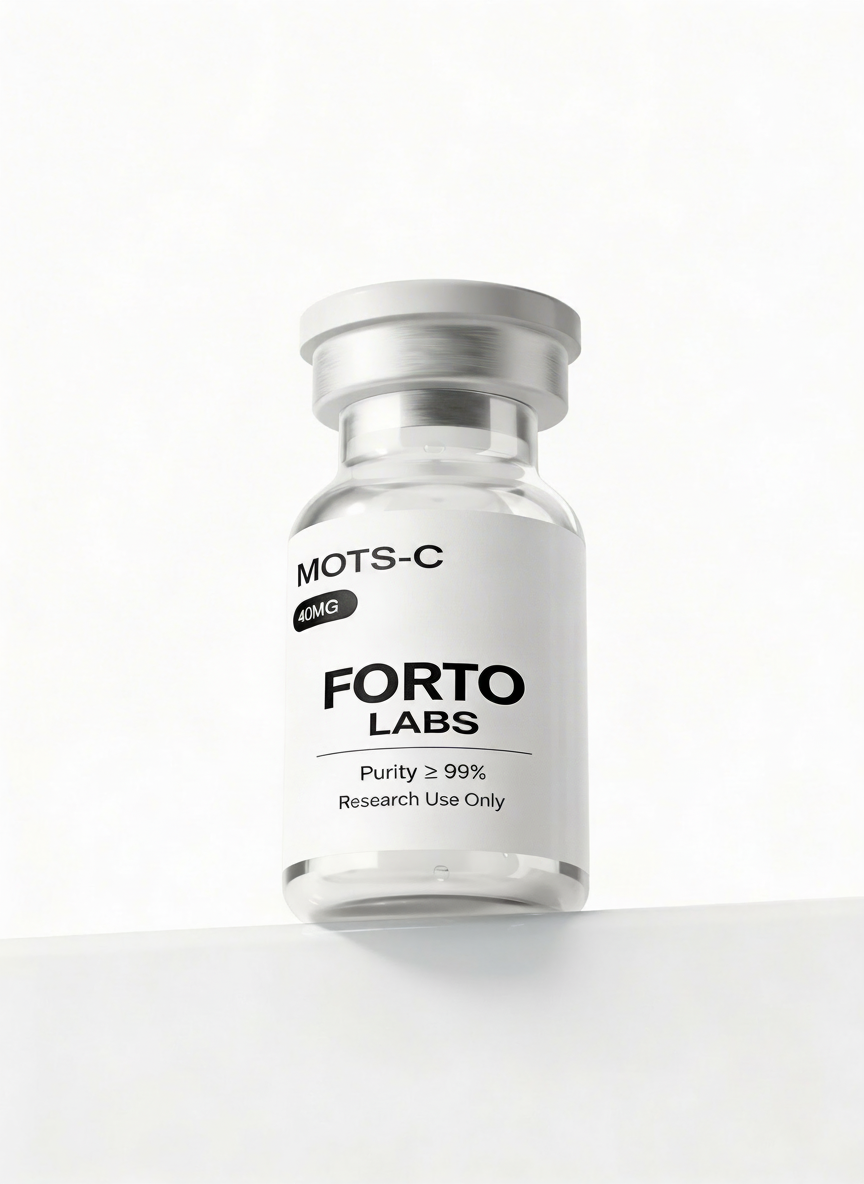
Key Statistics
| Statistic | Value | Detail |
|---|---|---|
| Running Time | 2× | Aged mice performance |
| Lifespan Increase | 6.4% | Median lifespan in mice |
| Muscle Expression | 11.9× | Post-exercise increase |
| Activation | AMPK | Master metabolic switch |
| Peptide Length | 16aa | Mitochondrial-derived |
Mechanism of Action
Exercise in a Molecule
MOTS-c is a 16-amino acid peptide encoded in the mitochondrial genome. When released, it travels to skeletal muscle where it activates AMPK — the same master metabolic switch triggered by exercise. This leads to improved glucose uptake, enhanced fat burning, and better insulin sensitivity without actual physical activity.
Biological Pathways
Folate-AICAR-AMPK Pathway (Primary)
AMP-Activated Protein Kinase
- Increases glucose uptake
- Enhances fatty acid oxidation
- Improves insulin sensitivity
Nuclear Translocation (Secondary)
Nuclear Gene Regulation
- Regulates stress response genes
- Promotes metabolic adaptation
- Enhances cellular resilience
NAD+/SIRT1 Pathway (Supportive)
Sirtuin 1 Signaling
- Increases NAD+ levels
- Activates longevity genes
- Enhances mitochondrial function
Key Mechanism
Why It Mimics Exercise
MOTS-c is naturally released from muscles during exercise. When given exogenously, it replicates metabolic benefits of physical activity by activating the same AMPK-dependent pathways.
Source: Lee et al., Cell Metabolism (2015)
| Metric | Value |
|---|---|
| Muscle MOTS-c (post-exercise) | ↑ 11.9× |
| Plasma MOTS-c (post-exercise) | ↑ 1.6× |
| MOTS-c levels (age 70-81) | ↓ ~21% |
| MOTS-c in obese subjects | ↓ ~16% |
Clinical Findings
| Metric | Value | Context |
|---|---|---|
| Running Time in Aged Mice | 2× improved | MOTS-c treated vs control |
| Diet-Induced Obesity Prevention | 100% | High-fat diet mice |
| MRSA Survival | 79% | vs 20% untreated |
Most data comes from preclinical studies in mice. The analog CB4211 has completed Phase 1a in healthy humans and is in Phase 1b for NAFLD.
Preclinical Effects
| Effect | Model | Value |
|---|---|---|
| Insulin Sensitivity (aged) | Aged mice | 100% restored |
| Body Weight (HFD) | High-fat diet mice | 85% of control |
| Fat Oxidation | Metabolic assay | 140% increase |
| Max Lifespan Extension | Aged mice | +7% |
Research Areas
Metabolism — Metabolic homeostasis
Prevents obesity and restores insulin sensitivity by enhancing metabolic flexibility
Source: Lee et al., Cell Metab (2015)
Bone Health — Osteoporosis protection
Reduced bone loss by inhibiting osteoclast formation and promoting bone repair
Source: Ming et al. (2016)
Cardiovascular — Heart & vascular protection
Reduced vascular calcification and improved cardiac function
Source: Wei et al. (2020)
Immune Function — Enhanced infection resistance
Dramatically improved MRSA survival in mice by enhancing macrophage bactericidal capacity
Source: ADDF Report
Dosing Protocols
Mouse Study Protocol
Dose: 15 mg/kg (exercise mimetic) or 5 mg/kg (insulin sensitivity) | Frequency: 3× weekly IP or daily IP | Duration: Varies by study
- Human equivalent dose approximately 5-10 mg
- Effects seen within days to weeks
- No tolerance development observed
Human Research Protocol
Dose: 5-10 mg SubQ | Frequency: 3-5× weekly | Duration: Typical cycle
- Based on human equivalent dosing calculations
- No official human protocol established
- CB4211 analog dosed once daily in trials
Pharmacokinetics
| Parameter | Value |
|---|---|
| Half-Life | ~2-4 hours |
| Peak Concentration | Skeletal muscle primary target |
| Bioavailability | SubQ or IM injection |
| Stability | Extremely unstable at RT (85-90% loss in 2-3hrs) |
| Excretion | Standard peptide degradation |
| Metabolism | Does not cross blood-brain barrier |
Safety Profile
| Issue | Incidence | Severity |
|---|---|---|
| Fatigue | 15% | Mild |
| Nausea | 10% | Mild |
| Headache | 8% | Mild |
- CB4211 analog well tolerated in 7-day Phase 1a trial
- No serious adverse events in preclinical studies
- Males show greater metabolic dysfunction when MOTS-c is low
Compound Information
| Property | Value |
|---|---|
| Type | Mitochondrial-derived peptide |
| CAS Number | N/A (research compound) |
| Molecular Weight | 2,174.6 g/mol |
| Amino Acids | 16 |
| Sequence | MRWQEMGYIFYPRKLR |
| Formula | C101H152N28O22S2 |
Frequently Asked Questions
Q: What is MOTS-c and where does it come from?
A: MOTS-c is a 16-amino acid peptide encoded within the mitochondrial genome, discovered in 2015 by Dr. Pinchas Cohen at USC. It is one of the few known bioactive peptides produced by mitochondrial DNA.
Q: Why is MOTS-c called an ‘exercise mimetic’?
A: MOTS-c is naturally produced and released from skeletal muscle during exercise — levels increase 11.9-fold. When administered exogenously, it activates the same AMPK pathways triggered by physical activity.
Q: What happened with human clinical trials?
A: MOTS-c itself has not been tested in formal human trials. CohBar’s analog CB4211 completed Phase 1a and is in Phase 1b for obesity and NAFLD.
Q: Why is MOTS-c storage so critical?
A: MOTS-c is extremely temperature sensitive — levels decrease 85-90% at room temperature within 2-3 hours. It must be kept frozen and reconstituted immediately before use.
References
- Lee C, et al. (2015) “The Mitochondrial-Derived Peptide MOTS-c Promotes Metabolic Homeostasis and Reduces Obesity and Insulin Resistance” Cell Metabolism
- Reynolds JC, et al. (2021) “MOTS-c is an exercise-induced mitochondrial-encoded regulator of age-dependent physical decline” Nature Communications
- Wei M, et al. (2020) “MOTS-c and Endothelial Function” Cardiorenal Medicine
- Reynolds JC, et al. (2021) “MOTS-c Improves Physical Performance and Extends Healthspan in Aged Mice” Cell Reports