
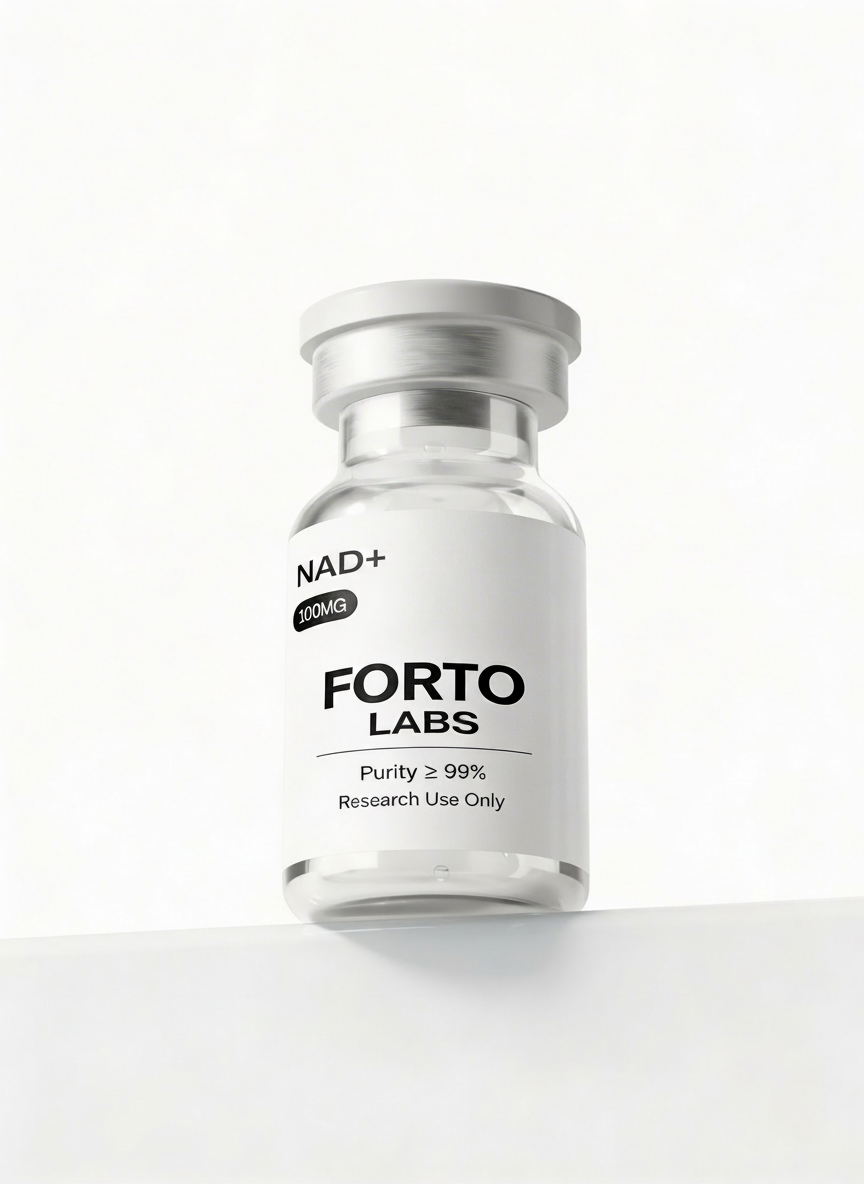
Key Statistics
| Statistic | Value | Detail |
|---|---|---|
| Decline by Age | 50% | NAD+ levels decrease with aging |
| Sirtuins Activated | 7 | SIRT1-7 longevity pathways |
| Cellular Reactions | 500+ | Essential metabolic cofactor |
| Clinical Subjects | 1,518 | Large-scale human research |
| Energy Metabolism | ATP | Mitochondrial function |
Mechanism of Action
Sirtuin & Mitochondrial Activation
NAD+ is the essential substrate for sirtuins (SIRT1-7), a family of enzymes that regulate aging, inflammation, stress resistance, and metabolism. It also fuels PARP DNA repair enzymes and is essential for mitochondrial energy production.
Biological Pathways
Sirtuin Activation (Primary)
SIRT1-7 Longevity Enzymes
- Regulates aging processes
- Controls inflammation
- Enhances stress resistance
DNA Repair (PARP) (Critical)
Poly-ADP-Ribose Polymerase
- Detects DNA damage
- Repairs single-strand breaks
- Maintains genomic integrity
Mitochondrial Function (Essential)
Electron Transport Chain
- Generates cellular ATP
- Powers energy production
- Supports cellular metabolism
Key Mechanism
Age-Related NAD+ Decline
NAD+ decline creates a ‘pseudohypoxic’ state that disrupts mitochondrial-nuclear communication. A 2022 study of 1,518 participants found significant age-related decline, particularly in men.
Source: Yang et al. (2022)
| Metric | Value |
|---|---|
| Men NAD+ Level | 34.5 μmol/L |
| Women NAD+ Level | 31.3 μmol/L |
| Age 40-49 Decline (β) | -1.12 |
| Age 60+ Decline (β) | -2.16 |
Clinical Findings
| Metric | Value | Context |
|---|---|---|
| Electron Transport Support | +95% | Mitochondrial function |
| ATP Synthesis | +90% | Energy production |
| Redox Balance | +85% | Cellular homeostasis |
Results from community-based cohort study of 1,518 participants. NAD+ measured using validated LC-MS/MS assay.
Preclinical Effects
| Effect | Model | Value |
|---|---|---|
| SIRT1 Activation | Metabolism & inflammation | Essential substrate |
| SIRT3 Activation | Mitochondrial function | Essential substrate |
| SIRT6 Activation | DNA repair & stability | Essential substrate |
| PARP1 Support | Single-strand break repair | Critical cofactor |
Research Areas
Longevity Pathways — Sirtuin-mediated benefits
NAD+ activates SIRT1-7 enzymes regulating cellular aging, metabolism, inflammation, and stress response
Source: Imai & Guarente (2014)
Cellular Energy — Mitochondrial support
NAD+ is critical for electron transport chain and ATP production
Source: Circulation (2019)
DNA Maintenance — PARP enzyme support
NAD+ powers DNA repair enzymes that maintain genomic integrity. PARP and CD38 activity increases with age.
Source: Katsyuba et al. (2020)
Cardiovascular Health — Cardiac function support
NAD+ homeostasis linked to cardiovascular health and aging
Source: Circulation Research (2018)
Dosing Protocols
IV Infusion Protocol
Dose: 500mg NAD+ | Frequency: Initial: single session; Maintenance: every 2-4 weeks | Duration: 2-4 hour infusion per session
- Slow infusion rate reduces side effects
- Sessions typically 2-6 hours depending on dose
- Hydration before and during recommended
High-Dose Protocol
Dose: 750-1000mg | Frequency: As needed | Duration: 4-6 hour infusion
- Only for experienced recipients
- Requires slower infusion rate
- Medical supervision essential
Pharmacokinetics
| Parameter | Value |
|---|---|
| Half-Life | Variable by tissue |
| Peak Concentration | Immediate (IV direct) |
| Bioavailability | 100% (IV), variable (oral precursors) |
| Stability | Intracellular salvage pathway |
| Excretion | Recycled via salvage pathway |
| Metabolism | Salvage pathway recycling |
Safety Profile
| Issue | Incidence | Severity |
|---|---|---|
| Nausea | 40% | Mild |
| Flushing/Warmth | 35% | Mild |
| Chest tightness | 25% | Mild |
- Side effects primarily related to infusion rate, not total dose
- First session often most challenging — tolerance develops over time
- Most effects resolve by slowing or pausing infusion
Compound Information
| Property | Value |
|---|---|
| Type | Endogenous dinucleotide coenzyme |
| CAS Number | 53-84-9 |
| Molecular Weight | 663.43 g/mol |
| Amino Acids | N/A (coenzyme) |
| Sequence | Nicotinamide + Adenine + Ribose + Phosphate |
| Formula | C21H27N7O14P2 |
Frequently Asked Questions
Q: What is NAD+ and why is it important?
A: NAD+ is a coenzyme present in every cell, essential for over 500 enzymatic reactions including energy production, DNA repair via PARPs, and activation of longevity-related sirtuins. NAD+ levels decline by up to 50% between ages 40-60.
Q: How does IV NAD+ differ from oral supplements?
A: IV NAD+ delivers directly into the bloodstream with 100% bioavailability. Oral precursors like NMN and NR must be converted through enzymatic pathways with variable efficiency.
Q: What does the research show about NAD+ and aging?
A: A 2022 study of 1,518 participants found significant age-related NAD+ decline, particularly in men. Significant decline was observed in the 40-49 age group, becoming more pronounced after age 60.
Q: What should I expect during an IV NAD+ session?
A: Sessions typically last 2-6 hours. Common experiences include temporary nausea, flushing, chest tightness — managed by slowing infusion rate. Side effects diminish with subsequent treatments.
References
- Yang F, et al. (2022) “Association of Human Whole Blood NAD+ Contents With Aging” Frontiers in Endocrinology DOI: 10.3389/fendo.2022.829658 PMID: 35370948
- Imai S, Guarente L (2014) “NAD+ and Sirtuins in Aging and Disease” Trends in Cell Biology PMID: 24786309
- Abdellatif M, et al. (2019) “NAD+ Metabolism in Cardiac Health, Aging, and Disease” Circulation PMID: 31508207
- Katsyuba E, et al. (2020) “NAD+ Homeostasis in Health and Disease” Nature Reviews Molecular Cell Biology PMID: 32694684
- Kane AE, Sinclair DA (2018) “Sirtuins and NAD+ in Metabolic and Cardiovascular Diseases” Circulation Research PMID: 30355082