
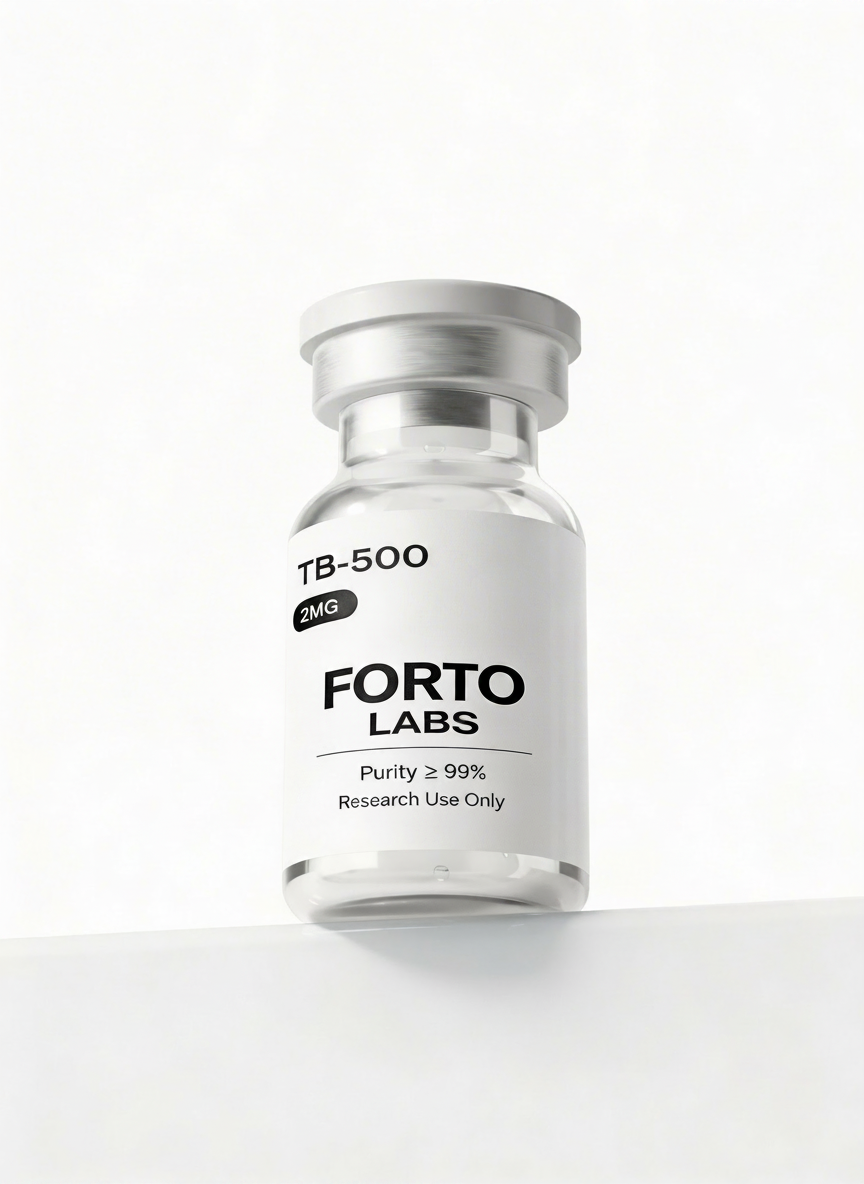
Key Statistics
| Statistic | Value | Detail |
|---|---|---|
| Faster Re-epithelialization | 61% | vs controls at 7 days |
| Serious Adverse Events | 0 | Phase 1 trial (42-1260mg IV) |
| Cited Studies | 170+ | Goldstein et al. review |
| Amino Acids | 43 | Naturally occurring peptide |
| Half-Life | 0.95-1.9hrs | Dose-dependent (42-1260mg IV) |
Mechanism of Action
Multi-Pathway Regeneration Mechanism
Thymosin Beta-4 (TB-500) is a naturally occurring 43-amino acid peptide that plays a vital role in tissue repair and regeneration. It sequesters G-actin monomers, promotes cell migration, inhibits inflammation, and stimulates angiogenesis — creating optimal conditions for healing after injury.
Biological Pathways
G-Actin Sequestration (Primary)
Monomeric Globular Actin Binding
- Regulates actin polymerization
- Enables cytoskeletal remodeling
- Facilitates cell motility and migration
Integrin-Linked Kinase (Primary)
ILK/PINCH/Parvin Complex Activation
- Promotes cell survival signaling
- Activates Akt pathway
- Supports cardiac cell migration
Anti-Inflammatory Pathways (Modulatory)
NF-κB and Toll-like Receptor Modulation
- Reduces inflammatory cytokines
- Ameliorates inflammatory damage
- Activates pro-resolving pathways
Key Mechanism
Actin-Based Cell Migration
TB-500 binds to G-actin monomers, preventing premature polymerization and allowing coordinated cytoskeletal remodeling. This promotes efficient cell migration to injury sites — a critical step in wound healing and tissue regeneration.
Source: J Invest Dermatol (1999)
| Metric | Value |
|---|---|
| Cell Migration | ↑ 2-3x increase |
| Re-epithelialization (Day 7) | ↑ 61% |
| Wound Contraction | ↑ 11% more |
| Collagen Deposition | ↑ Increased |
Clinical Findings
| Metric | Value | Context |
|---|---|---|
| Serious Adverse Events (Phase 1) | 0 | 42-1260mg IV, 14 days |
| Re-epithelialization (Day 7) | 61% | Full-thickness wound model |
| Keratinocyte Migration | 200% | 2-3 fold increase |
Most wound healing evidence comes from preclinical (animal) studies. Human Phase 1 data confirms safety but efficacy trials are ongoing. FDA approval has not been granted.
Preclinical Effects
| Effect | Model | Value |
|---|---|---|
| Optimal Neurological Dose | Quartic regression | 3.75 mg/kg |
| Phase 1 Completion Rate | 40 healthy volunteers | 100% |
| ILK Activation (Cardiac) | Heart injury model | +90% |
| Cardiomyocyte Migration | Cell motility assay | +85% |
Research Areas
Wound Healing — Accelerated wound closure and re-epithelialization
61% faster re-epithelialization at 7 days in animal models
Source: J Invest Dermatol
Cardiac Repair — Cardioprotective effects via ILK activation
Activates ILK, promotes cardiomyocyte survival and migration
Source: Nature (2004)
Neuro Recovery — Improved functional outcome in stroke/TBI models
Promotes oligodendrogenesis and axonal remodeling
Source: J Neurol Sci
Corneal Healing — Dry eye and corneal wound healing
Phase 2 trials completed for dry eye disease
Source: Clin Ophthalmol
Dosing Protocols
Human Clinical Trial (Phase 1)
Dose: 42-1260mg IV (ascending doses) | Frequency: Single dose, then daily × 14 days | Duration: 14 days
- All doses well tolerated
- Half-life increased with dose (0.95-1.9 hrs)
- Dose-proportional pharmacokinetic response
Preclinical (Animal Studies)
Dose: 2-12 mg/kg (optimal: 3.75 mg/kg) | Frequency: IP, day 1 then q3d × 5 doses | Duration: Varies by study
- Optimal dose calculated via quartic regression
- Ceiling effect at 18 mg/kg
- Treatment initiated 24h after injury
Pharmacokinetics
| Parameter | Value |
|---|---|
| Half-Life | 0.95-1.9 hours (dose-dependent) |
| Peak Concentration | ~15 min post-dose (IV) |
| Bioavailability | Dose-proportional response |
| Stability | Present in all tissues naturally |
| Excretion | Standard peptide degradation |
| Metabolism | Endogenous recycling |
Safety Profile
| Issue | Incidence | Severity |
|---|---|---|
| Headache | 15% | mild |
| Upper Respiratory Infection | 10% | mild |
| Injection Site Reactions | 5% | mild |
- No serious adverse events in any Phase 1 cohort (42-1260mg)
- No dose-limiting toxicities identified
- All adverse events were mild or moderate in intensity
- NOEL ≥18 mg/kg in rats and dogs
Compound Information
| Property | Value |
|---|---|
| Type | Endogenous peptide / synthetic analog |
| CAS Number | 77591-33-4 |
| Molecular Weight | 4,963 Da |
| Amino Acids | 43 |
| Sequence | 17LKKTET22 (actin binding region) |
| Formula | Thymosin Beta-4 fragment |
Frequently Asked Questions
Q: What is TB-500 and where does it come from?
A: TB-500 is a synthetic version of Thymosin Beta-4, a naturally occurring 43-amino acid peptide first identified in the thymus gland in the 1960s. It is present in virtually all cells, with high concentrations in blood platelets and wound fluid.
Q: Is TB-500 FDA approved?
A: No. It is an investigational drug that has completed Phase 1 safety trials and Phase 2 trials for dry eye disease. It is banned by WADA under category S0.
Q: What does the research show?
A: Preclinical research shows TB-500 accelerates wound healing (61% faster), promotes cell migration, reduces inflammation, and supports tissue regeneration. Human Phase 1 trials demonstrated safety at IV doses up to 1260mg daily for 14 days.
Q: How does TB-500 differ from BPC-157?
A: TB-500 works through G-actin sequestration for cell migration, while BPC-157 activates VEGFR2-Akt-eNOS for angiogenesis. They are often studied together due to complementary mechanisms.
References
- Goldstein AL, et al. (2012) “Thymosin β4: a multi-functional regenerative peptide” Expert Opinion on Biological Therapy DOI: 10.1517/14712598.2012.634793 PMID: 22074294
- Ruff D, et al. (2010) “A randomized, placebo-controlled study of IV thymosin beta4” Annals of the New York Academy of Sciences DOI: 10.1111/j.1749-6632.2010.05474.x PMID: 20536472
- Malinda KM, et al. (1999) “Thymosin beta4 accelerates wound healing” Journal of Investigative Dermatology DOI: 10.1046/j.1523-1747.1999.00708.x PMID: 10469335
- Bock-Marquette I, et al. (2004) “Thymosin beta4 activates ILK and promotes cardiac cell migration and repair” Nature DOI: 10.1038/nature03000 PMID: 15565145
- Morris DC, et al. (2014) “Dose Response Study of Thymosin β4 for Acute Stroke” Journal of the Neurological Sciences DOI: 10.1016/j.jns.2014.07.006 PMID: 25060418
- Sosne G, Ousler GW (2015) “Thymosin beta 4 ophthalmic solution for dry eye: Phase II clinical trial” Clinical Ophthalmology DOI: 10.2147/OPTH.S80954 PMID: 26056426