
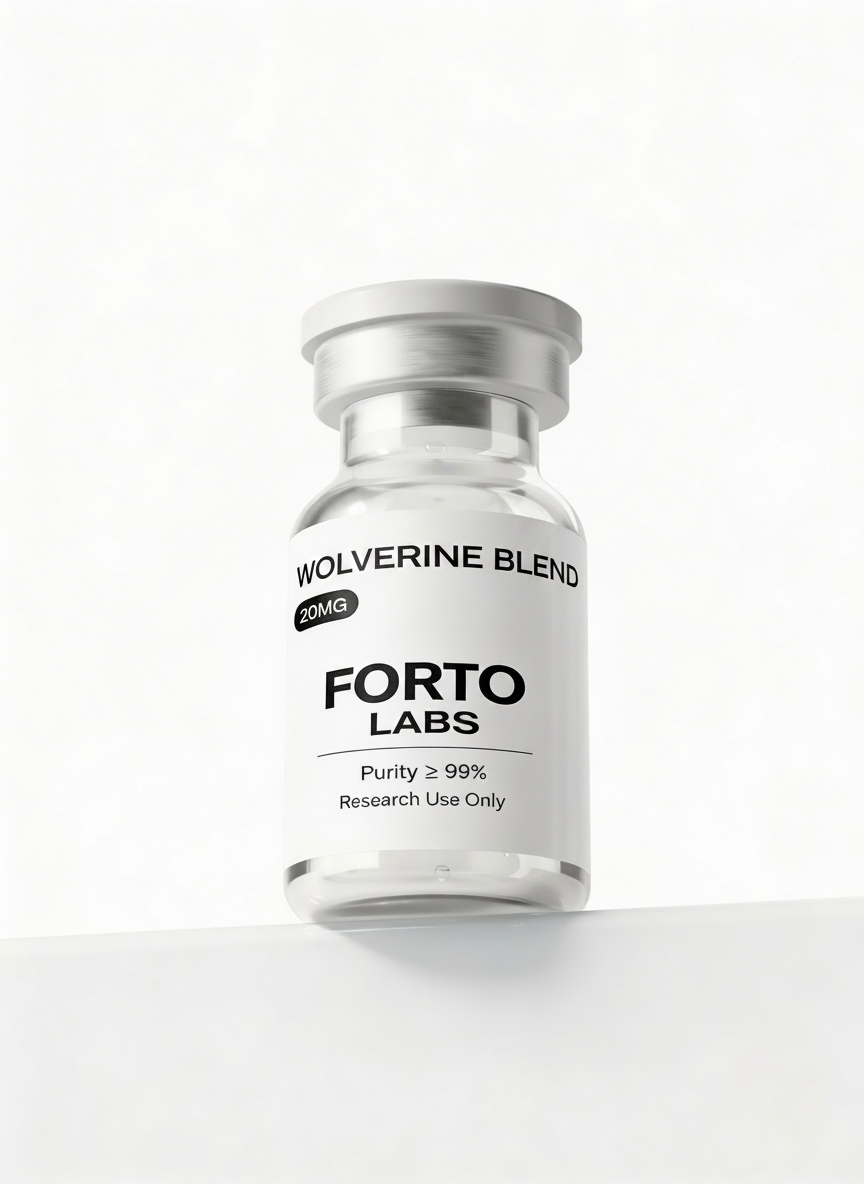
Key Statistics
| Statistic | Value | Detail |
|---|---|---|
| GHR Upregulation | 7× | BPC-157 day 3 (tendon) |
| Faster Healing | 61% | TB-500 re-epithelialization |
| Achieved | No LD50 | Both peptides in toxicity studies |
| Combined Studies | 370+ | 200+ BPC + 170+ TB-500 |
| Pathways | 2 | Distinct complementary mechanisms |
Mechanism of Action
Dual-Pathway Synergy
The Wolverine Stack combines two peptides with distinct but complementary mechanisms. BPC-157 promotes angiogenesis (blood vessel formation) through VEGFR2 signaling, while TB-500 enhances cell migration through G-actin regulation. Together, they create optimal conditions for tissue repair by addressing both vascular supply and cellular mobility.
Biological Pathways
VEGFR2 Pathway (BPC-157) (Primary)
Vascular Endothelial Growth Factor
- Promotes new blood vessel formation
- Increases blood flow to injured areas
- Activates endothelial cell proliferation
G-Actin Sequestration (TB-500) (Primary)
Monomeric Globular Actin Binding
- Regulates cytoskeletal remodeling
- Facilitates cell motility and migration
- Enables wound closure mechanisms
Anti-Inflammatory (Both) (Modulatory)
Inflammation Modulation Pathways
- Reduces pro-inflammatory cytokines
- Modulates NF-κB signaling
- Promotes resolution of inflammation
Key Mechanism
Complementary Regenerative Pathways
BPC-157 and TB-500 work through different but convergent mechanisms. BPC-157 promotes blood vessel formation through VEGFR2-Akt-eNOS signaling, while TB-500 promotes cell migration by regulating actin dynamics. Both reduce inflammation — creating optimal healing conditions from multiple angles.
Source: GlobalRPH (2025)
| Metric | Value |
|---|---|
| BPC-157 Primary Action | Angiogenesis (VEGF) |
| TB-500 Primary Action | Cell Migration (Actin) |
| Overlap | Anti-inflammatory |
| Combined Effect | Comprehensive repair |
Clinical Findings
| Metric | Value | Context |
|---|---|---|
| Distinct Complementary Mechanisms | 2 Pathways | Preclinical + Phase 1 Human Data |
| BPC-157 Cell Migration | 70% faster | Individual component efficacy |
| TB-500 Re-epithelialization | 61% faster | Individual component efficacy |
No formal combination clinical trials exist. Data is derived from individual peptide studies. The synergistic potential is inferred from complementary mechanisms of action.
Preclinical Effects
| Effect | Model | Value |
|---|---|---|
| Tendon Healing (BPC-157) | Transection model | 50% faster |
| Wound Closure (TB-500) | Full-thickness wound | 61% faster |
| Muscle Repair (BPC-157) | Crush injury model | 40% faster |
| Neuro Recovery (TB-500) | Stroke model | 35% improvement |
Research Areas
Tendon & Ligament — BPC-157 fibroblast outgrowth + TB-500 cell migration
Complementary tissue repair mechanisms
Source: J Applied Physiology
Wound Healing — Angiogenesis + keratinocyte migration
61% faster + increased blood supply
Source: J Invest Dermatol
Muscle Recovery — FAK/paxillin + actin regulation pathways
Dual pathway muscle repair support
Source: Expert Opin Biol Ther
Anti-Inflammatory — NF-κB modulation from both peptides
Dual inflammation control pathways
Source: PMC Function Review
Dosing Protocols
BPC-157 Preclinical Protocol
Dose: 10μg/kg standard, 1-6mg oral (human Phase 1) | Frequency: 1-2x daily | Duration: Varies by study
- Effective across a 1000-fold dose range
- No dose-limiting toxicity identified
- Oral bioavailability confirmed (gastric stable 24+ hrs)
TB-500 Clinical Protocol
Dose: 42-1260mg IV (Phase 1) | Frequency: Single, then daily × 14 days | Duration: 14 days
- All doses well tolerated with no dose-limiting toxicities
- Half-life: 0.95-1.9 hours (dose-dependent)
- Optimal neurological dose: 3.75 mg/kg
Pharmacokinetics
| Parameter | Value |
|---|---|
| Half-Life | BPC-157: <30min; TB-500: 0.95-1.9hrs |
| Peak Concentration | BPC-157: 3-9min (IM); TB-500: ~15min (IV) |
| Bioavailability | BPC-157: 14-51% (species-dependent) |
| Stability | BPC-157: 24+ hrs in gastric juice |
| Excretion | Standard peptide degradation |
| Metabolism | Degraded to amino acids |
Safety Profile
| Issue | Incidence | Severity |
|---|---|---|
| Injection Site Reactions | 10% | mild |
| Headache | 15% | mild |
| GI Discomfort | 5% | mild |
- BPC-157: No lethal dose reached in preclinical toxicology
- TB-500: No serious adverse events at doses up to 1260mg IV
- Both peptides show favorable safety profiles in available data
Compound Information
| Property | Value |
|---|---|
| Type | Dual peptide blend |
| CAS Number | BPC: 137525-51-0 / TB: 77591-33-4 |
| Molecular Weight | BPC: 1,419.5 Da / TB: 4,963 Da |
| Amino Acids | BPC: 15 / TB: 43 |
| Sequence | BPC: GEPPPGKPADDAGLV / TB: 17LKKTET22 (active region) |
| Formula | BPC: C62H98N16O22 / TB: Thymosin Beta-4 fragment |
Frequently Asked Questions
Q: Why is this combination called the ‘Wolverine Stack’?
A: The name references the Marvel character Wolverine, known for rapid healing. BPC-157 and TB-500 work through complementary pathways — BPC-157 promotes blood vessel formation while TB-500 enhances cell migration — addressing multiple aspects of tissue repair.
Q: Are there any formal studies on the combination?
A: No formal clinical trials have been published specifically on the BPC-157 + TB-500 combination. The synergistic potential is inferred from their complementary mechanisms and independent efficacy data.
Q: How do the mechanisms complement each other?
A: BPC-157 primarily works through the VEGFR2-Akt-eNOS pathway for angiogenesis, while TB-500 works through G-actin sequestration for cell migration. For tissue repair, you need both: blood vessels to supply nutrients, and cells that can migrate to the injury site.
Q: What is the safety profile of this combination?
A: Both peptides individually have favorable safety profiles. BPC-157 has no established LD50, and TB-500 Phase 1 trials showed no serious adverse events at IV doses up to 1260mg. However, no combination safety studies exist.
Q: Are these peptides legal to use?
A: Neither is FDA approved for human therapeutic use. Both are banned by WADA under category S0 and classified as unapproved drugs by the FDA.
References
- McAuley D (2025) “BPC-157 and TB-500: Background, Indications, Efficacy, and Safety” GlobalRPH Clinical Review
- Vasireddi N, et al. (2025) “Emerging Use of BPC-157 in Orthopaedic Sports Medicine: A Systematic Review” HSS Journal (NIH/PubMed Central) DOI: 10.1177/15563316251355551 PMID: 40756949
- Goldstein AL, et al. (2012) “Thymosin β4: a multi-functional regenerative peptide” Expert Opinion on Biological Therapy DOI: 10.1517/14712598.2012.634793 PMID: 22074294
- Ruff D, et al. (2010) “A randomized, placebo-controlled study of intravenous thymosin beta4 in healthy volunteers” Annals of the New York Academy of Sciences DOI: 10.1111/j.1749-6632.2010.05474.x PMID: 20536472
- Malinda KM, et al. (1999) “Thymosin beta4 accelerates wound healing” Journal of Investigative Dermatology DOI: 10.1046/j.1523-1747.1999.00708.x PMID: 10469335
- Chang CH, et al. (2011) “The promoting effect of BPC 157 on tendon healing” Journal of Applied Physiology DOI: 10.1152/japplphysiol.00945.2010 PMID: 21030672